
Wholesale window shutters are window covering products — primarily plantation shutters, venetian blinds, and window shades — purchased in commercial quantities directly from manufacturers or authorised distributors for resale or project supply. For ANZ wholesale buyers, the sourcing decision centres on three variables: landed cost per unit, supply consistency across reorders, and the supplier's ability to meet the quality and compliance expectations of the Australian and New Zealand market. This guide covers what factory-direct sourcing actually delivers on each of those variables, the manufacturing quality indicators that predict long-term supplier reliability, and the questions every wholesale buyer should ask before committing to a supply relationship.
What "Factory-Direct" Actually Means for Wholesale Shutter Pricing
The Middleman Cost Layer That Factory-Direct Removes
Most wholesale window shutter supply chains in the ANZ market pass through at least one intermediary layer between the factory and the wholesale buyer — a trading company, an import agent, or a regional distributor operating as a reseller. Each layer adds a margin: typically 15–25% at the trading company level, and a further 10–20% at the regional distributor level if both are present. On a product category where factory FOB pricing runs USD $80–$180 per set for plantation shutters, those margins represent a meaningful cost difference per container.
Factory-direct sourcing eliminates those layers. The wholesale buyer contracts directly with the production facility, receives factory pricing, and has direct access to the production team for specification changes, QC queries, and lead time management. The trade-off is that factory-direct relationships require more active management — there is no intermediary absorbing communication friction or handling local logistics — but for mid-to-large wholesale buyers with sufficient volume and in-house import capability, the cost advantage and supply chain transparency are substantial.
Why FOB Pricing Is Only Part of the Total Cost Picture
FOB price is the most visible cost variable when evaluating wholesale window shutter suppliers, but it is rarely the most important one over a 12–36 month supply relationship. The costs that are harder to see at the quotation stage — replacement product for quality failures, expedited freight for delayed orders, staff time managing supplier disputes, and lost sales during stockouts — typically exceed the initial FOB saving from choosing a lower-priced supplier.
A factory offering a 12% lower FOB price but with inconsistent colour batching, variable tolerance management, or weak packaging will cost more in total than a factory at the higher price point with documented QC systems and a track record of consistent output. The evaluation criteria in this guide are structured around identifying which factory is which before the first container is ordered.
The Three Product Lines Every Wholesale Shutter Supplier Should Offer
The most commercially efficient wholesale window shutter sourcing arrangement is a single supplier covering three complementary product lines — plantation shutters, venetian blinds, and window shades — within one container. This structure allows buyers to reach container minimums across product categories rather than requiring full container volumes in a single product type, and it reduces the freight, quality management, and supplier relationship overhead of running multiple factory accounts.
| Product Line | Materials Available | Standard Lead Time | Container Fit | Primary Market Application |
|---|---|---|---|---|
| Plantation Shutters | Timber (basswood, ash, FSC pine), PVC, Aluminium (6063-T5) | 25–35 days | Primary volume product | Residential renovation, commercial hospitality, heritage properties |
| Venetian Blinds | Timber (25mm, 50mm slats), PVC | 20–30 days | Volume fill, high reorder frequency | Residential and commercial standard window specification |
| Window Shades | Roller (standard and blackout), Zebra/Day-Night, Honeycomb, Shangri-La, Roman | 7–15 days | Fast-moving SKUs, urgent restocking | Residential, commercial, aged care, education |
| Mixed Container | All three lines combined | Longest lead time governs | One 20GP minimum across all lines | One-stop ANZ wholesale sourcing |
Note: Lead times are based on confirmed purchase order to ex-factory. Port-to-port transit to major ANZ ports adds approximately 18–22 days from Shenzhen.
For ANZ wholesale buyers, plantation shutters are typically the anchor category driving container volume — they carry the highest unit price and the strongest retail margin — with venetian blinds and window shades filling the remaining container space and serving higher-frequency reorder patterns. Explore our plantation shutter product range and timber versus aluminium shutter specifications for detailed product-line guidance.
The Two Manufacturing Variables That Predict Long-Term Supplier Reliability
Most wholesale buyers evaluate shutter factories on price, sample quality, and the factory's stated certifications. These are necessary but not sufficient criteria. The two manufacturing variables that most reliably predict whether a supply relationship will hold up over 24–36 months of reordering are tolerance management during production and colour batch consistency across orders. Both are invisible at the sample stage and only become apparent after multiple reorders.
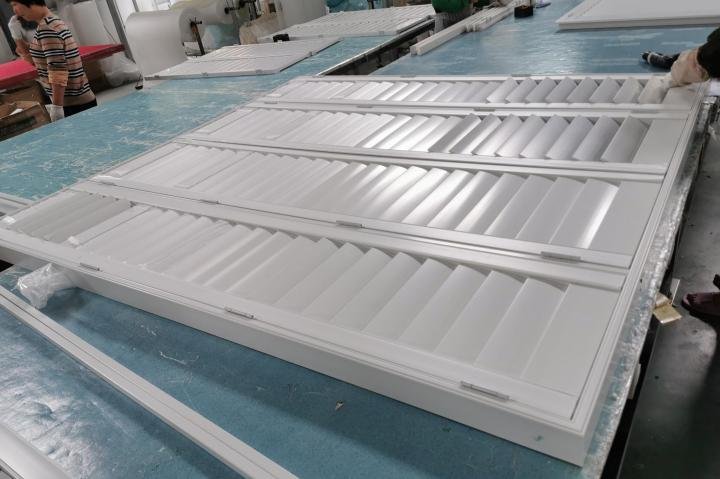 📸 Image: QC technician measuring louvre profile cross-section with precision callipers during in-process inspection. Conveys active tolerance management rather than end-of-line inspection only.
Quality Variable 1 — Manufacturing Tolerances and Delayed Failure
The most commercially damaging quality failures in wholesale shutter supply are the ones that do not appear in outgoing factory inspection but emerge 12–18 months after installation. Tolerance drift during PVC extrusion is a prime example. The designed wall thickness tolerance for PVC louvre profiles is ±0.1mm. When an extrusion line runs unchecked for extended periods, actual wall thickness tolerance can drift to ±0.3mm — a difference that produces no visible defect in the finished product and passes standard outgoing inspection.
The failure mode appears later. PVC louvres undergo thermal expansion and contraction daily as installed window temperatures cycle. Over 12–18 months, a louvre produced at the outer boundary of a ±0.3mm tolerance accumulates enough dimensional drift that the louvre-lock gap — designed at 0.2mm — widens to 0.5mm or more in the closed position. The result is a light gap at mid-panel in closed shutters: a callback that arrives a year after installation and is almost always attributed by the installer to a product defect rather than a manufacturing process control failure.
The correct mitigation is in-process frequency of wall thickness checks, not end-of-line inspection. Checking every 30 minutes rather than every four hours catches tolerance drift before it affects a full production run. When evaluating a supplier, ask specifically how often in-process dimensional checks are conducted and what the response protocol is when a check returns an out-of-tolerance reading. A supplier who can answer that question with a specific number and a documented corrective action procedure has the process control in place; one who cannot is relying on final inspection alone.
For further guidance on factory audit criteria, see what separates reliable plantation shutter manufacturers from the rest.
Quality Variable 2 — Colour Batch Consistency Across Reorders
Colour batch inconsistency is the most common cause of wholesale distributor callbacks that reach the end consumer. The scenario: a distributor sells plantation shutters to a homeowner completing a staged renovation. The first order — two rooms — is installed. Six months later, the remaining two rooms are ordered as a restock. The new batch arrives in what is nominally the same colour, but under natural light the two batches are visibly different. The homeowner holds the distributor responsible.
The root cause is almost always the absence of a formal colour lock-value system at the manufacturing stage. The correct process uses a spectrophotometer under a D65 standard light source (6500K, CRI >90) to measure finished product Lab* values from the first production run, establishing a locked colour standard for that client and that colour code. Every subsequent production run is compared against the locked standard; a colour difference (ΔE, CIE 2000 formula) of ≤1.0 is accepted, and anything above 1.5 is flagged for rework before dispatch.
This system requires a spectrophotometer, a colour archive, and a documented comparison protocol — equipment and process that mid-size factories frequently do not maintain because the upfront investment is not visible to buyers during the sample stage. The question to ask any wholesale window shutter supplier is: "How do you manage colour consistency between reorders?" A factory with a documented colour lock-value system will be able to describe the process in specific terms. A factory without one will give a general answer about "quality control."
Compliance Verification: What ANZ Wholesale Buyers Need to Check
Compliance requirements for wholesale window shutters sold into the ANZ market cover three distinct areas: chemical safety, structural safety, and environmental certification. These are separate document sets and should be requested independently.
| Compliance Area | Standard / Regulation | What to Request from Supplier | ANZ Market Relevance |
|---|---|---|---|
| Chemical safety — PVC and coatings | REACH SVHC (EU) / AICIS (Australia) | REACH-SVHC declaration (ICP-OES or XRF test method stated); separate from RoHS declaration | Increasingly required by ANZ retail chain buyers; AICIS aligning with REACH |
| Cord safety | ACCC Consumer Protection Notice 2014 No. 7 | Product conformity statement; test report if corded products | Mandatory for products sold to ANZ consumers via retail channels |
| UV and colour stability — PVC | ASTM G154 (UV-A 340nm cycling) | Third-party test report; minimum 500h ΔE ≤3.0; preferably ΔE ≤1.5 | Critical for ANZ UV exposure levels, which exceed European benchmarks by approximately 40% |
| Timber sourcing | FSC Chain of Custody (FSC-STD-40-004) | Active FSC certificate number (verify at info.fsc.org); must cover the specific product category | Growing requirement from ANZ retail chains and green building project specifiers |
| Moisture and structural integrity | AS/NZS 4858 (wet area materials) | Dimensional change test results for PVC products; ≤0.5% after 24h immersion | Relevant for bathroom and high-humidity installation environments |
| Formaldehyde — composite timber | CARB P2 (ATCM 93120) | CARB P2 test report for finger-jointed timber and MDF components | Referenced by ANZ retail chain procurement conditions |
Note that REACH compliance and RoHS compliance are two separate declarations covering different substance lists. A supplier providing one in response to a request for the other should be asked to clarify. Similarly, an FSC certificate number should be independently verified at the FSC public database before it is relied upon in a product specification or marketing claim.
Supply Chain Checklist: Eight Questions to Ask Any Wholesale Window Shutter Supplier
Before committing to a first container order, wholesale buyers should be able to get clear, specific answers to the following questions. Vague or deflected answers are informative in themselves.
- What is your in-process inspection frequency for dimensional tolerances? (Looking for: a specific time interval and a documented response procedure, not "we check at end of line.")
- How do you manage colour consistency between reorders of the same colour code? (Looking for: spectrophotometer-based colour lock-value system with a stated ΔE tolerance.)
- Which third-party laboratory conducts your UV yellowing tests, and what is the test duration? (Looking for: SGS / Intertek / Bureau Veritas; minimum 500 hours ASTM G154.)
- Can you provide the FSC certificate number for your timber product line, and which product categories does it cover? (Verify independently at info.fsc.org before accepting.)
- What is your pre-shipment inspection protocol — does it occur before or after products are packed into boxes? (Looking for: inspection after boxing, not at the finished-goods stage before packing.)
- Do you offer regional exclusivity for ANZ wholesale partners? (Looking for: a clear yes/no and the basis on which territory is defined.)
- What is your process when a colour or dimensional nonconformance is identified after the container has shipped? (Looking for: a documented claims process with stated resolution timelines — not "we'll discuss it.")
- Can you provide a Pre-Production Sample (PPS) produced using actual production materials and processes before the first full order? (A PPS is distinct from an initial development sample and is a more reliable predictor of batch quality.)
Bright Shutters: Factory-Direct Wholesale Window Shutters for ANZ
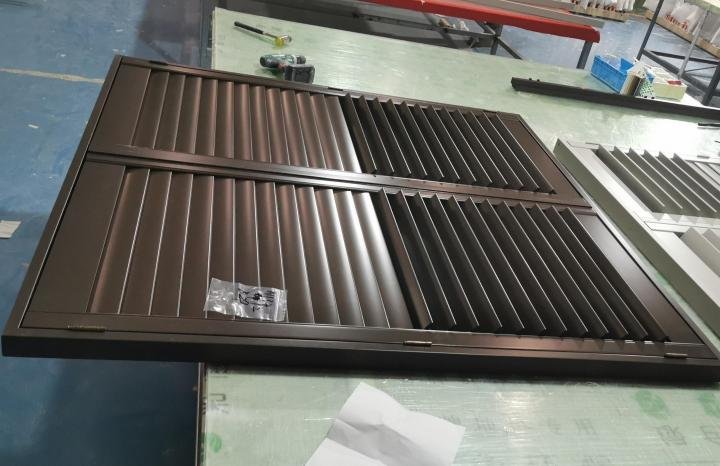 📸 Image: Wide-angle production floor showing plantation shutter, venetian blind, and window shade lines active simultaneously. Brand signage visible. Conveys full-category manufacturing scale.
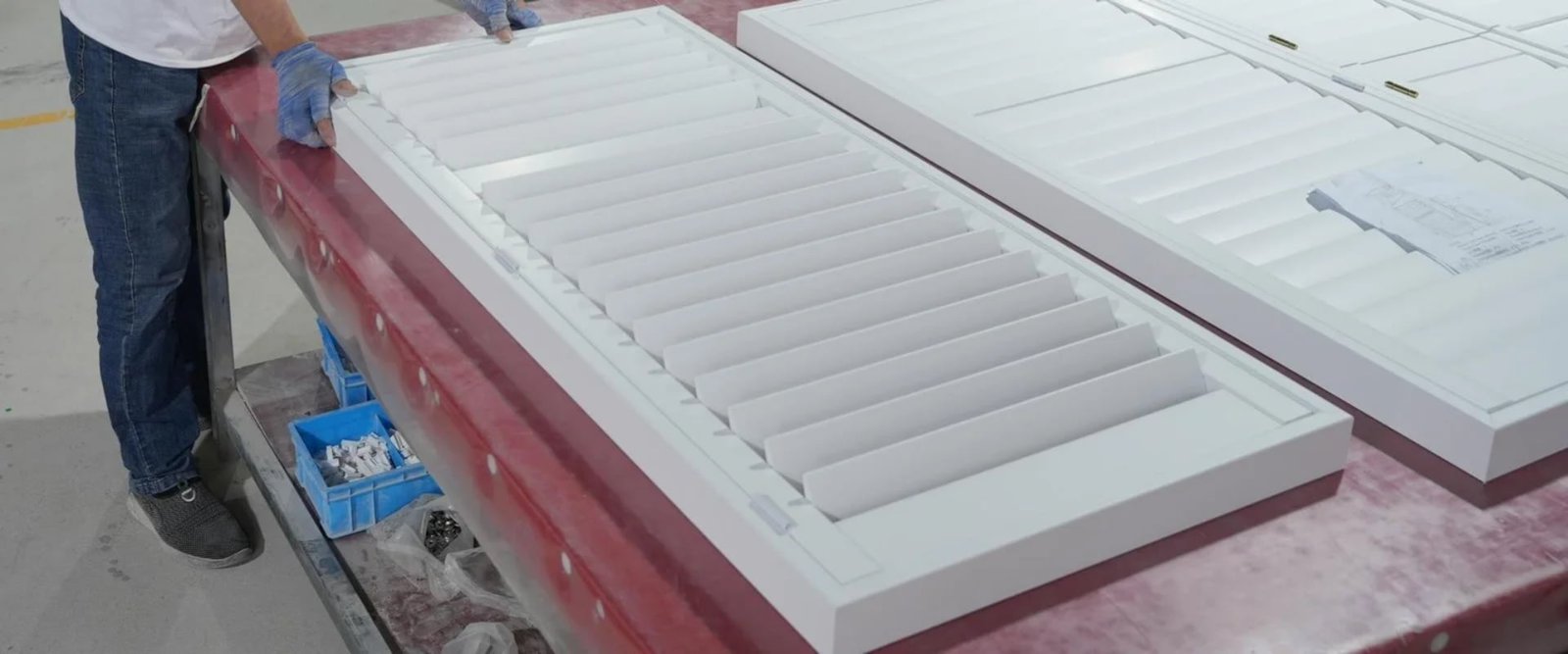
Bright Shutters is a factory-direct manufacturer of wholesale window shutters and window coverings operating from a 58,883㎡ production facility in Shenzhen, China. The facility runs 12 dedicated production lines across plantation shutters (timber, PVC, and aluminium), venetian blinds, and the full range of window shades. Quality control is managed by a 16-person in-house QC team that operates independently of the production department and reports directly to the quality director. Cumulative output since 2010 exceeds 11 million sets across all product lines.
For ANZ wholesale partners, Bright Shutters offers:
- Factory-direct pricing with no trading company or agent margin layer
- Mixed 20GP container ordering across all three product lines — one supplier, one container, one freight arrangement
- Regional exclusivity — one authorised wholesale partner per defined ANZ territory
- FSC-certified pine plantation shutters for green building and eco-conscious project specifications
- 6063-T5 aluminium plantation shutters with powder coating verified at 60–80μm DFT
- OEM and ODM branding and packaging from the first container order
- 3–7 day sample lead times before first container commitment
Standard lead times run 25–35 days (plantation shutters), 20–30 days (venetian blinds), and 7–15 days (window shades) from confirmed purchase order, with port-to-port transit to major ANZ ports adding approximately 18–22 days.
Frequently Asked Questions
Q: What is the minimum order quantity for wholesale window shutters from a factory-direct supplier?
A: At Bright Shutters, the minimum order is one 20-foot general purpose container (20GP). This minimum can be met by combining plantation shutters, venetian blinds, and window shades across a single order — buyers are not required to fill a container with one product type. A typical mixed 20GP container carries approximately 200–350 sets of plantation shutters, depending on louvre size and panel dimensions, with venetian blinds and window shades filling remaining space. Sample sets are available prior to a first container order, with a 3–7 day sampling lead time.
Q: How do factory-direct wholesale shutter prices compare to buying through an ANZ distributor or trading company?
A: Factory-direct pricing typically delivers a 20–40% cost advantage over purchasing through an established ANZ wholesale distributor, and a 35–50% advantage compared to a two-layer supply chain (trading company plus regional distributor). The exact margin depends on product specification, volume, and container utilisation. The comparison should account for total landed cost — including freight, customs clearance, and any inspection fees — not FOB price alone. Factory-direct buyers also absorb import logistics directly, which requires in-house capability or a reliable freight forwarder relationship.
Q: How can I verify that the batch quality I receive matches the original sample?
A: This is the most important quality risk in wholesale shutter sourcing, and it is not reliably managed by sample evaluation alone. The correct approach involves three steps: first, request a Pre-Production Sample (PPS) produced using actual production-line materials and processes — not a hand-finished development sample. Second, specify in the purchase contract that all batch quality parameters (dimensions, colour, coating thickness) are measured against the PPS, not against a general specification. Third, arrange a third-party In-Process Inspection (IPI) at the 50% production milestone, which allows nonconformances to be corrected before the full run is completed. An IPI at this stage costs significantly less than a rework or replacement claim after the container arrives. Bright Shutters accommodates third-party IPI as standard practice on all orders.
Q: Are wholesale window shutters from China compliant with Australian consumer safety regulations?
A: Products sold into the ANZ consumer market via retail channels must comply with the ACCC Consumer Protection Notice 2014 No. 7, which governs cord safety for window coverings. Products with operating cords must meet specific cord length and loop size requirements, or incorporate safety devices. Wholesale buyers supplying retail channels should request a product conformity statement from the factory for every corded product in their range. B2B wholesale buyers supplying commercial project contractors (rather than consumer retail) operate under a lighter direct compliance burden, but remain responsible for ensuring downstream buyers understand applicable requirements. Bright Shutters provides conformity documentation for all products supplied to ANZ retail-channel wholesale accounts.
Q: What lead time should I build into my inventory planning for wholesale window shutter reorders?
A: For standard reorder planning from Shenzhen to major ANZ ports (Sydney, Melbourne, Auckland), the realistic total lead time is: 7–15 days for window shades, 20–30 days for venetian blinds, and 25–35 days for plantation shutters (all from confirmed purchase order to ex-factory), plus approximately 18–22 days port-to-port sea transit, plus 5–10 days for customs clearance and delivery to your warehouse. Total from order to stock: 30–45 days for shades, 43–67 days for venetian blinds, and 48–67 days for plantation shutters. For peak ANZ buying seasons (August–November), Bright Shutters recommends placing reorders 10–14 days earlier than the standard lead time calculation to buffer against port congestion.
Q: Does Bright Shutters offer regional exclusivity to ANZ wholesale partners?
A: Yes. Bright Shutters operates an exclusive-territory model in Australia and New Zealand: one authorised wholesale partner per defined region. The territory boundary is agreed at the start of the partnership and is designed to protect the partner's investment in local brand building, marketing, and customer relationships. Bright Shutters will not supply a competing wholesale account within a partner's defined territory. Regional exclusivity is available from the first container order and is documented in the partnership agreement.
Talk to the Bright Shutters Team
Sourcing wholesale window shutters factory-direct from Shenzhen involves more due diligence upfront than buying from an established local distributor — but it also delivers meaningful cost advantages and supply chain control that become more valuable as your volume grows. If you are evaluating factory-direct sourcing for the first time, or reassessing your current supplier relationship, Bright Shutters' production team works with ANZ wholesale accounts daily and can provide sample sets, technical specification sheets, REACH and FSC compliance documentation, and a confirmed lead time and pricing structure for your specific product requirements.
Contact us directly to request a sample set or discuss your first container order.