
China Manufacturing Capabilities for Australia & New Zealand Trade Supply
A single-source manufacturer -- not a trading company or an assembler. Here's what's inside our facility.
Get a Wholesale Quote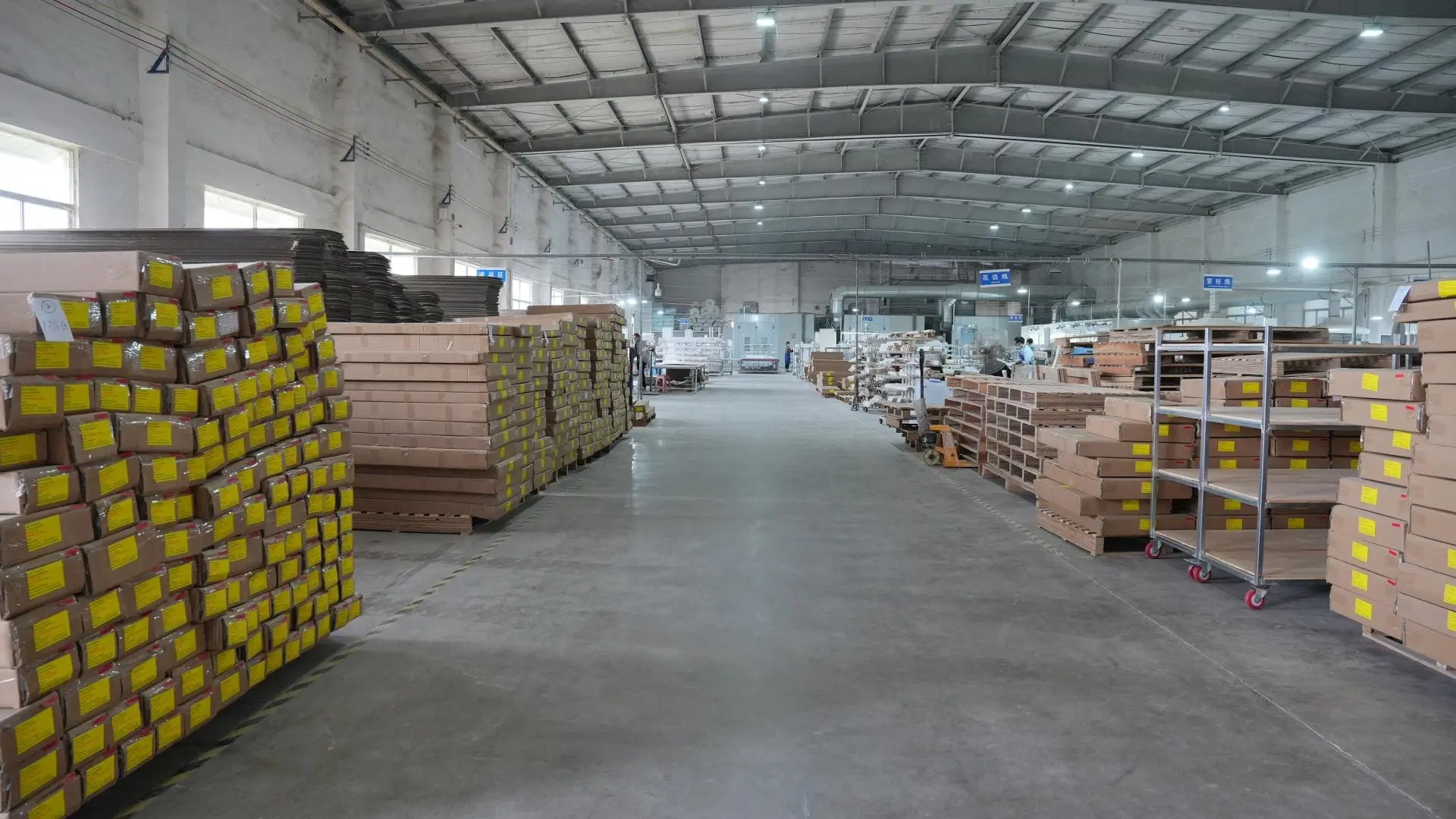
PRODUCTION
INFRASTRUCTURE.
THREE PRODUCT LINES.
ONE FACILITY.
PLANTATION SHUTTERS
Units per year across timber, PVC and aluminium material streams. CNC machining centres deliver tight tolerances on wood; 50+ PVC extrusion lines support 200+ profile sections.
View RangeVENETIAN BLINDS
Units per year in genuine basswood and high-density PVC. Three automated coating lines ensure colour consistency across mixed-container orders with batch tolerances within ΔE <1.5.
View RangeWINDOW SHADES
Units per year across roller, zebra, honeycomb and flyscreen systems. 6 dedicated honeycomb heat-press lines; motorisation-ready cassette systems. Lead times 7-15 days ex-factory.
View Range
FROM RESIN TO
FINISHED SHUTTER.
PVC plantation shutters for interior use are manufactured through a fully integrated process in our Shenzhen facility. Unlike timber shutters that require external wood sourcing, PVC shutters start from virgin PVC resin compound and progress through extrusion, precision cutting, assembly and quality inspection -- all under one roof. This vertical integration ensures consistent material properties, dimensional accuracy and colour matching across production batches.
PVC RESIN MIXING & STABILIZATION
Virgin PVC resin (K-value 65-67) is blended with calcium-zinc heat stabilizers, impact modifiers, UV absorbers and colour masterbatch in high-speed mixers. Formulation ratios are controlled to achieve Shore D hardness 75-80 and Vicat softening point ≥78°C. Mixed compound is stored in silos for 24-hour aging before extrusion to ensure homogeneous dispersion.

50+ EXTRUSION LINES, 200+ PROFILE SECTIONS
Conical twin-screw extruders (L/D ratio 25:1) melt and homogenize the PVC compound at 170-185°C. Molten material is forced through precision-machined steel dies to form continuous profiles: stiles (vertical frames), rails (horizontal frames), louvre blades, tilt rods and hinge posts. Each profile exits through calibration sleeves and water-cooling tanks to lock in dimensional accuracy. Inline thickness gauges monitor wall sections; profiles exceeding ±0.2mm tolerance are automatically rejected.

CNC PROFILE PROCESSING
Extruded profiles are cut to order-specific lengths using double-head mitre saws (±0.5mm accuracy). Stiles and rails then move to CNC routing centres for mortise-and-tenon joinery preparation: mortise pockets are milled into stiles to receive rail tenons, and louvre pin holes are drilled at precise intervals (typically 25-38mm spacing) along the stile inner face. Hole positioning accuracy is critical -- tolerance ±0.3mm -- to ensure louvres rotate smoothly without binding.
Louvre blades are cut to width, then staple holes are punched at both ends to accept tilt rod staples. All cut edges are deburred with abrasive wheels to remove sharp corners and ensure safe handling during assembly.

STRUCTURAL INTEGRATION
Stiles and rails are assembled into rectangular frames using mortise-and-tenon joints reinforced with PVC welding or mechanical fasteners (depending on frame size and load requirements). Frame squareness is verified with digital protractors; diagonal measurements must match within 2mm.
Louvre blades are inserted into the pre-drilled pin holes in the stiles. Each louvre is secured with nylon or stainless steel pivot pins that allow 180° rotation. Tilt rods are then attached to louvre ends via staples, creating a synchronized tilting mechanism. Rod alignment is checked: all louvres must open/close uniformly without individual blade lag or resistance.

MECHANICAL COMPONENTS & OPERATIONAL VALIDATION
Hinges, magnetic catches and mounting brackets are installed. For bi-fold or multi-panel configurations, panel alignment and hinge clearance are adjusted to ensure smooth folding action without frame collision.
Each completed shutter panel undergoes functional testing: louvres are cycled through full open/close positions 20 times to verify smooth operation and consistent tilt rod engagement. Hinges are tested for swing clearance and load-bearing capacity (minimum 15kg per hinge pair). Any units exhibiting binding, misalignment or excessive noise are routed back for adjustment.

FQC VERIFICATION & EXPORT PREPARATION
Final Quality Control (FQC) inspectors verify dimensional accuracy (width, height, squareness), surface finish (no scratches, colour uniformity ΔE <1.5), and operational smoothness. UV anti-yellowing resistance is spot-checked using accelerated aging chambers (168-hour UV exposure equivalent to 12 months outdoor sunlight; colour shift must remain <ΔE 2.0).
Approved panels are wrapped in protective PE film, corner guards are applied, and units are packed into corrugated cartons with foam inserts. Cartons are labeled with order number, panel dimensions, colour code and installation orientation. For sea freight, cartons are palletized and stretch-wrapped; pallet configurations are optimized for 20ft/40ft container loading efficiency.

STRUCTURAL DESIGN ADVANTAGES OF PVC PLANTATION SHUTTERS
- Moisture Resistance: Unlike timber, PVC does not absorb water or warp in high-humidity environments (bathrooms, coastal areas). Dimensional stability maintained across -10°C to +60°C temperature range.
- Colour Consistency: Pigments are compounded into the PVC matrix during extrusion, not surface-applied. Eliminates paint chipping or fading issues common in painted timber shutters.
- Lightweight Construction: PVC density ~1.4 g/cm³ vs. timber 0.5-0.8 g/cm³, but hollow-core extrusion design achieves similar structural rigidity at 30-40% lower weight. Reduces hinge load and installation complexity for large panels.
- Termite & Rot Immunity: PVC is inert to biological attack. Suitable for ground-floor installations and regions with high termite activity where timber shutters require chemical treatment.

LIMITATION: PVC PROFILE SIZE CONSTRAINTS
While PVC extrusion allows precise control over profile geometry, maximum extrudable cross-section is limited by die size and cooling uniformity. For shutter stiles wider than 115mm or louvre blades exceeding 114mm width, structural rigidity may require internal aluminium reinforcement inserts (increasing cost and weight). Timber shutters can achieve wider single-piece components without reinforcement, making them preferable for large-scale architectural openings (>2400mm height).
PLANTATION SHUTTERS
PRODUCTION PROCESS.
Our solid wood plantation shutters undergo 8 major manufacturing stages from raw timber selection to final assembly. Each wooden component is processed through CNC machining centres, multi-stage sanding, UV-cured coating lines, and precision joinery before quality inspection.

RAW TIMBER SELECTION & INSPECTION
Western Red Cedar and basswood boards sourced from certified suppliers. IQC inspection verifies moisture content ≤12%, straight grain pattern, and absence of knots >6mm diameter in louvre zones. Boards stacked for 48-hour acclimatisation.

CNC PRECISION CUTTING
20+ CNC machining centres cut stiles, rails, and louvres to order-specific dimensions. Louvre width options: 47mm, 63mm, 89mm, 114mm. Tolerance ±0.2mm on critical dimensions. Mortise-and-tenon joint profiles machined for frame assembly.

EDGE PROFILING & ROUTING
Router stations apply decorative edge profiles to louvres (elliptical, bevelled, or flat options) and frame components. Dust extraction systems maintain workshop air quality. Components inspected for splinter-free edges before sanding stage.

MULTI-STAGE SANDING
Three-pass sanding sequence: 120-grit rough sanding removes machining marks, 180-grit intermediate sanding smooths grain, 240-grit final sanding prepares surface for coating. Automated belt sanders for flat surfaces; hand-sanding for profiled edges.

STAINING & UV-CURED COATING
Water-based stains applied in climate-controlled booths (21°C, 50% RH). Three automated coating lines apply primer, colour coat, and UV-cured topcoat. Target dry film thickness 40-60μm. Colour consistency monitored with spectrophotometer (ΔE <1.5 batch-to-batch).

LOUVRE PIN DRILLING & INSERTION
CNC drill stations create precision holes in stiles for louvre pivot pins. Stainless steel pins (Ø4mm) inserted and secured. Pin spacing calculated per louvre width to ensure ±2° tilt angle consistency across panel height. IPQC checks pin alignment every 50 units.

FRAME ASSEMBLY & TILT ROD INSTALLATION
Mortise-and-tenon joints secured with wood glue and pneumatic pin nailers. Tilt rod mechanisms (centre-tilt or offset-tilt) installed and calibrated. Assembly jigs ensure square corners (±1mm diagonal tolerance). Clamps hold frames for 30-minute cure time.

FINAL INSPECTION & PACKAGING
FQC inspectors verify dimensions against order specs, test louvre tilt smoothness (full 180° rotation), check coating uniformity, and confirm hinge/magnetic catch function. Approved panels wrapped in protective film, boxed with foam corner guards, and labelled for container loading.
PRODUCTION LEAD TIME NOTE
Standard solid wood plantation shutters require 20-30 days ex-factory from order confirmation. Custom louvre widths, non-standard frame dimensions, or colour-matching requests may extend lead times by 5-10 days. Sample production dispatched within 3-7 business days for specification approval before full production run.
LEAD TIMES & LOGISTICS.
3-7 DAYS SAMPLING
Physical samples dispatched within one week. International courier shipping (DHL/FedEx) to ANZ addresses. No minimum order quantity for sample requests.
20-30 DAYS SHUTTERS & BLINDS
Production lead time for plantation shutters and venetian blinds from order confirmation to ex-factory. Add 18-25 days sea freight to Sydney/Melbourne/Auckland ports.
7-15 DAYS WINDOW SHADES
Faster turnaround for roller, zebra, honeycomb and flyscreen shades. Shortest total delivery time (production + shipping) approximately 4 weeks door-to-door to ANZ.
MIXED-CONTAINER ORDERS
Combine plantation shutters, venetian blinds and window shades in a single FCL. Minimum replenishment from 10 units per SKU. Reduces freight cost per unit for multi-product buyers.
SMALL-BATCH REPLENISHMENT
10-200 unit orders accepted for established partners. International courier shipping available for urgent top-up orders (3-5 day delivery ANZ). Supports just-in-time inventory strategies.


OEM / ODM CAPABILITIES.
CUSTOM COLOUR DEVELOPMENT
Match existing brand colour palettes or develop new finishes. Powder coating (aluminium), UV lacquer (timber), and co-extrusion pigment (PVC) all support custom colour formulation. Minimum order 500 units per colour for new formulations.
NEW PROFILE TOOLING
Design and manufacture custom PVC extrusion dies for unique frame/louvre profiles. Tooling lead time 7-14 days; first article samples within 3 days post-tooling. One-time tooling cost amortized across production runs.
BRANDED PACKAGING
Custom carton printing, branded poly bags, product labels and installation instruction inserts. Packaging artwork approved via digital proofs before print runs. Minimum 1,000 units for custom-printed cartons.
PROJECT-SPECIFIC HARDWARE
Custom hinge finishes, specialty tilt mechanisms, motorisation integration, and fire-rated hardware sourcing for commercial projects. Engineering support included for structural load calculations and installation method statements.
ANZ MARKET STRUCTURAL DESIGN
Frame reinforcement for larger openings common in ANZ architecture; corrosion-resistant hardware for coastal installations; UV-stabilized materials validated for high-UV southern hemisphere conditions. Design input from ANZ trade partners incorporated into product development.
DESIGNED FOR
AUSTRALIA &
NEW ZEALAND.
Over 14 years serving ANZ trade buyers, we've adapted our manufacturing processes to address the specific environmental and market requirements of Australia and New Zealand. These are not generic export products -- they're engineered for your market.
ANZ STANDARD SIZING SYSTEM
Our production templates align with Australia & New Zealand standard window dimensions. Common ANZ opening sizes (e.g., 600/900/1200/1500/1800mm widths) pre-configured in our order system to reduce custom-sizing errors and speed up quoting.
HIGH-UV CLIMATE VALIDATION
ANZ's high UV index (8-14 in summer) demands superior material stability. Our UV anti-yellowing tests simulate 2+ years southern hemisphere sun exposure. PVC formulations include dual UV stabilizer packages; timber coatings use UV-absorbing topcoats validated to ΔE <3.0 colour shift.
COASTAL ENVIRONMENT RESISTANCE
Moisture and salt-air testing protocols developed for ANZ coastal installations. Climate chamber cycling (30°C/90% RH to 20°C/40% RH) validates dimensional stability. Stainless steel hardware standard on aluminium shutters; marine-grade fasteners available for extreme coastal exposure.
ANZ TRADE PARTNER INPUT
Product improvements driven by feedback from Australian and New Zealand wholesalers, installers and project builders. Recent examples: reinforced Z-frame profiles for large bi-fold door shutters; quick-release tilt rod clips requested by installers; pre-drilled mounting holes aligned with ANZ brick veneer construction.

GET A WHOLESALE QUOTE.
Share your product requirements -- material, quantity, target market -- and our ANZ trade team will respond within 1 business day with factory pricing, lead times and available territory status.
Get a Wholesale Quote