
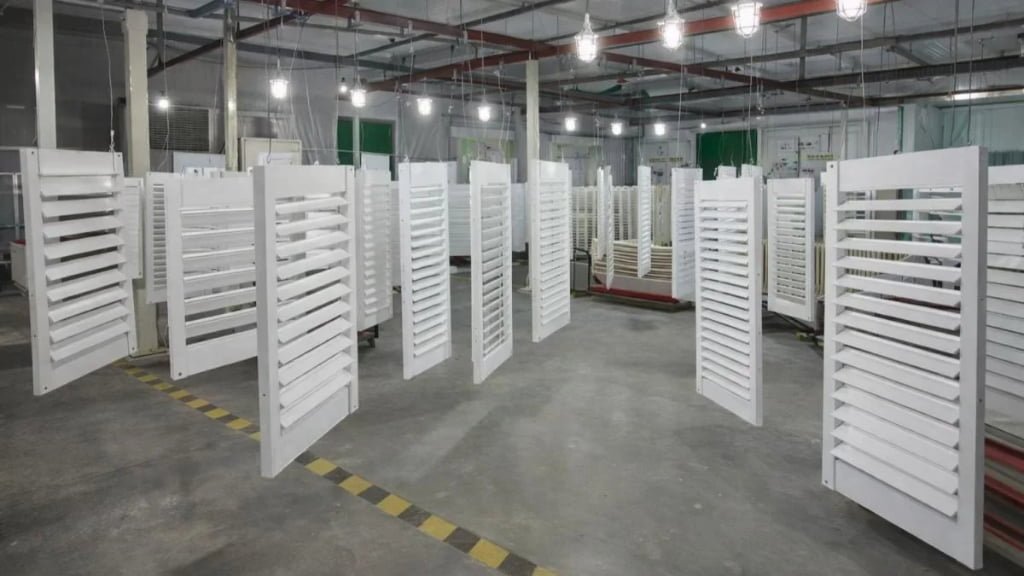
Wood plantation shutter manufacturers and aluminium plantation shutter manufacturers operate fundamentally different production processes — timber through kiln drying, CNC machining, and multi-coat painting; aluminium through profile extrusion, precision machining, and electrostatic powder coating. For ANZ wholesale buyers, these manufacturing differences are not cosmetic: they determine which material suits which climate zone, how each performs over a 10-year installation cycle, and where the price gap between them actually comes from.
This breakdown covers both production chains, the specific variables that separate reliable from unreliable product within each material category, and a direct application guide for the five most common ANZ wholesale buying scenarios.
The Production Chain: Where the Differences Begin
Timber Plantation Shutters — From Kiln to CNC to Paint
A timber plantation shutter enters production as kiln-dried lumber — basswood (椴木), ash (白蜡木), or pine (松木 / FSC-certified). The primary production stages are: kiln drying and moisture conditioning, cross-cut and rip sawing to rough dimensions, CNC machining to final louvre and frame geometry, surface preparation (sanding to 120-grit), primer application, and two to three topcoat passes. Each stage introduces quality variables that compound downstream — substandard kiln drying, in particular, creates defects that do not appear in factory inspection but manifest during sea transit or after installation.
The total production process for a standard timber shutter involves twelve to fifteen handling steps before packing, making it the more labour-intensive of the two material categories. Typical production lead time at Bright Shutters runs 25–35 days from confirmed purchase order, for standard specifications.
Aluminium Plantation Shutters — From Extrusion to Powder Coat
Aluminium shutters begin with profile extrusion: 6063-series aluminium billet is heated to approximately 480–520°C and forced through a steel die to form the cross-sectional profiles of louvre slats, frame sections, and hardware housings. After cooling and straightening, profiles are CNC-machined to final dimensions and assembled with the gear-and-rod tilt mechanism — the distinguishing structural element of aluminium plantation shutters. Final finishing is electrostatic powder coating, applied at 60–80μm dry film thickness and cured at 180–200°C for approximately 20 minutes.
Aluminium shutters require fewer production steps than timber and are less sensitive to ambient humidity during production, but introduce their own set of material specification variables that have significant implications for long-term product reliability.
The Manufacturing Variables That Determine Long-Term Performance
Timber: Why Moisture Management Is the Single Most Important Production Variable
The timber characteristic that most directly predicts long-term stability — and the one most commonly mismanaged — is moisture content at the point of CNC machining. The accepted range is 8–12%, and virtually every manufacturer will confirm their compliance. What this figure alone does not capture is the distinction between surface moisture content and core moisture content.
When lumber is kiln-dried too rapidly to meet production schedules, the exterior surface dries and locks dimensionally — a condition called case hardening — while the core retains moisture at 14–16%. Per ASTM D4442 moisture content testing protocols, a pin-type resistance moisture meter reads at 5–8mm depth (the surface layer only) and will return an acceptable reading on case-hardened timber. The core moisture is not detected.
This distinction matters specifically for ANZ buyers because of what happens during the three-week Pacific crossing. Inside a sealed container, temperature cycling between tropical and sub-tropical air masses creates humidity gradients. Case-hardened timber with a high-moisture core continues drying: internal stress releases progressively, and by the time the container reaches Sydney or Auckland, panels that measured acceptable at the factory have warped. The failure pattern is typically non-random — middle panels in a batch warp while the edge panels remain straight — which leads buyers to assume inconsistent material rather than a systematic kiln drying process failure. A robust IQC protocol uses cross-sectional oven-dry sampling (ASTM D4442 Method B) on every incoming batch, not pin-meter surface readings alone. The surface-to-core moisture differential should not exceed 2%.
Aluminium: The Alloy Specification That Separates Reliable From Problematic
The aluminium specification variable that most directly affects long-term product reliability is the temper state of the 6063 alloy. Per ASTM B221, 6063-T5 — cooled directly from extrusion temperature and artificially aged — provides a yield strength of ≥145 MPa and Vickers hardness of ≥60 HV. The T4 temper, achieved by natural aging alone, offers 110 MPa yield strength — 24% lower — at a material cost approximately 8% below T5.
The practical consequence of this difference is not visible during installation and does not appear in the first two to three years of use. In the gear-and-rod tilt mechanism, each louvre pivot hole carries a cyclic bending moment every time the tilt rod is operated. Under T4 material properties, the pivot hole experiences a fatigue wear rate approximately 2.3 times higher than under T5. By years five to seven of daily use, T4 pivot holes have expanded enough that louvres no longer hold position at intermediate angles — they slip to fully open or fully closed. This is the "louvre-sag" failure that arrives years after installation and is almost never traced back to the original alloy specification at time of manufacture. Visual inspection and standard hardness testing at goods receipt (Vickers HV, 5 kgf load) can verify T5 compliance; a reading below 60 HV should be treated as a nonconformance.
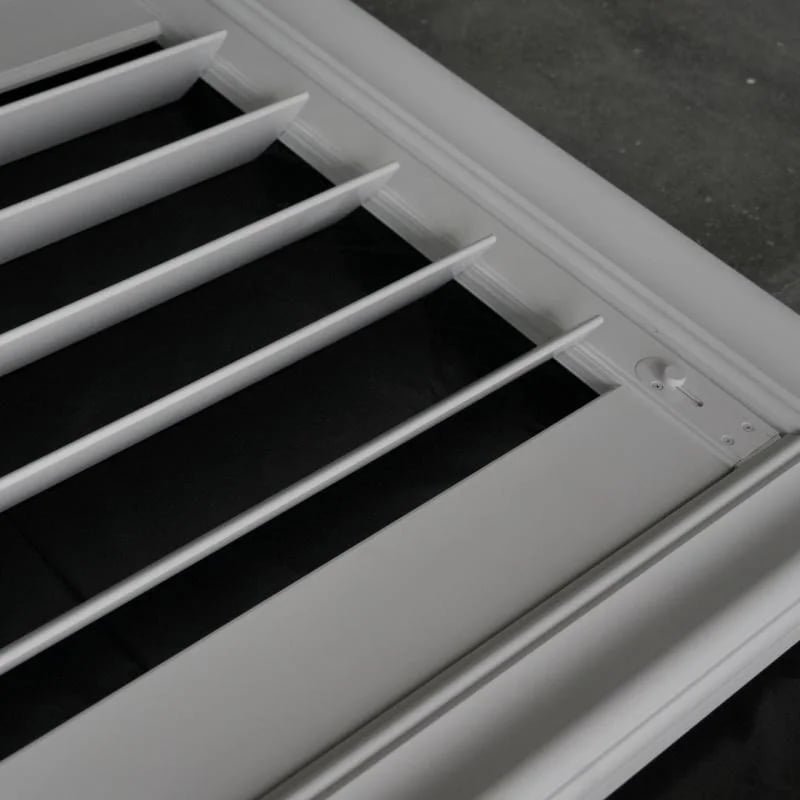 📸 Image: Close-up of aluminium shutter tilt mechanism assembly — gear rod, pivot housings, louvre ends visible. Communicates precision engineering and the relevance of alloy specification.
Side-by-Side: Performance, Weight, and Application Comparison
| Parameter | Timber (Basswood / Ash) | Aluminium (6063-T5) |
|---|---|---|
| Panel weight (700 × 2,100mm) | 5.3–8.2 kg (species-dependent) | 3.8–5.1 kg |
| Thermal expansion coefficient | 4–6 × 10⁻⁶ /°C | 23.1 × 10⁻⁶ /°C |
| Humidity sensitivity | Moderate–High | Negligible |
| Coastal salt air resistance | Moderate (finish-dependent) | High (60–80μm powder coat) |
| Operating noise in strong wind | Low | Moderate–High (metallic) |
| On-site surface repair | Yes (sand and repaint) | No (replacement required) |
| Suitable for >70% avg. humidity | Limited | Yes |
| Louvre sizes available | 47mm, 63mm, 76mm, 89mm | 63mm, 76mm, 89mm |
| Custom colour (post-installation) | Full repaint possible | Not practical |
| Hinge load per pair | Higher (density × panel area) | Lower |
| Standard lead time (Bright Shutters) | 25–35 days | 28–35 days |
| FSC-certified option | Yes (pine series) | N/A |
Note on coastal performance: aluminium shutters in coastal locations should be specified with powder coating verified at ≥60μm DFT and ASTM B117 1,000-hour salt spray compliance. Aluminium shutters at standard 40μm coating have shown red rust at Shenzhen coastal exposure equivalent within 18–24 months.
Note on operating noise: aluminium shutter louvre-to-frame contact in sustained winds above 14 m/s (approximately Force 7) produces audible metallic vibration. This is a structural characteristic, not a defect, and cannot be resolved by tightening louvres. For coastal or high-rise bedrooms, timber or PVC is the more appropriate specification.
What Drives the Price Difference?
| Cost Factor | Timber | Aluminium | Notes |
|---|---|---|---|
| Raw material | Kiln-dried lumber | 6063 alloy billet | Aluminium commodity pricing more volatile |
| Processing complexity | 12–15 steps | 8–10 steps | Timber more labour-intensive |
| Surface finish | Multi-coat painting (3–4 passes) | Powder coating (1 pass, automated) | Powder coat more consistent |
| Hardware | Standard hinges, tilt rod | Precision gear-rod system | Aluminium hardware adds complexity cost |
| QC inspection labour | Higher (moisture, grain, finish) | Lower (dimensional, hardness) | Timber QC more variable |
| Packaging | Standard foam-wrap | Standard foam-wrap | Similar |
| Typical factory-direct premium vs PVC | +15–25% | +20–35% | Varies by specification and louvre size |
The price premium for aluminium over timber (approximately 10–15% at factory-direct pricing) is driven primarily by the precision gear-rod mechanism and the higher alloy material cost, partially offset by lower painting labour. The gap narrows for large louvre sizes (89mm) where timber material cost is proportionally higher.
Application Guide: Five Scenarios and the Better Material Choice
-
Standard residential, inland locations (low humidity, no salt air): Either material performs well over a 10-year horizon. Timber offers better aesthetic flexibility (repaintable) and lower upfront cost. Aluminium offers lighter weight per panel (beneficial for large spans) and zero humidity concern. Recommended: Timber (basswood or FSC pine) for entry and mid-range; Aluminium for premium or large-format specifications.
-
Coastal residential (within 5km of saltwater, Queensland to South Australia coastal strip): Timber requires more diligent maintenance (annual coating inspection, refinishing every 5–7 years); aluminium with verified 60–80μm powder coating and ASTM B117 1,000-hour salt spray compliance requires no finish maintenance. However, note aluminium noise characteristics in exposed coastal locations — for bedrooms with direct sea exposure, PVC is often the most practical specification. Recommended: Aluminium (with verified coating spec) for non-bedroom spaces; PVC or timber for bedrooms in high-wind coastal zones.
-
Commercial hospitality (hotel rooms, serviced apartments): Operating cycle frequency (10+ operations per day) and multi-year durability without maintenance access are the key criteria. Aluminium T5 with a quality gear mechanism outperforms timber over a 10-year hospitality cycle. Timber risks moisture-related callbacks and surface wear in high-traffic rooms. Recommended: Aluminium (6063-T5, verified hardness ≥60 HV).
-
Large window spans (single pane >1,800mm wide): Both materials require mid-rail specification for spans above 1,800mm with 38mm louvres. Aluminium's lower panel weight (by 30–40% vs ash) reduces hinge load, which matters for spans running 2,000–2,400mm. Timber at this scale requires specification of higher-grade hinges (stainless 304 or brass, rated ≥6 kg/pair). Recommended: Aluminium for 2,000mm+ spans; timber viable with correct hinge specification.
-
Heritage or aesthetic-driven refurbishment: The ability to sand, repaint, and match existing colour profiles on-site is specific to timber. Aluminium cannot be practically refinished post-installation. For heritage properties (Federation, Queenslander, Victorian) or projects requiring colour-matched integration with existing joinery, timber is the only viable specification. Recommended: Timber (species and finish per project-specific design brief).
Bright Shutters: Factory-Direct Timber and Aluminium Plantation Shutters for ANZ Wholesalers
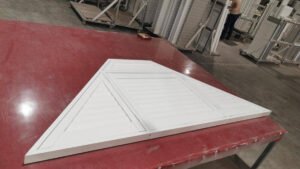
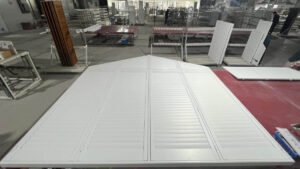
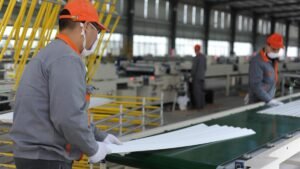
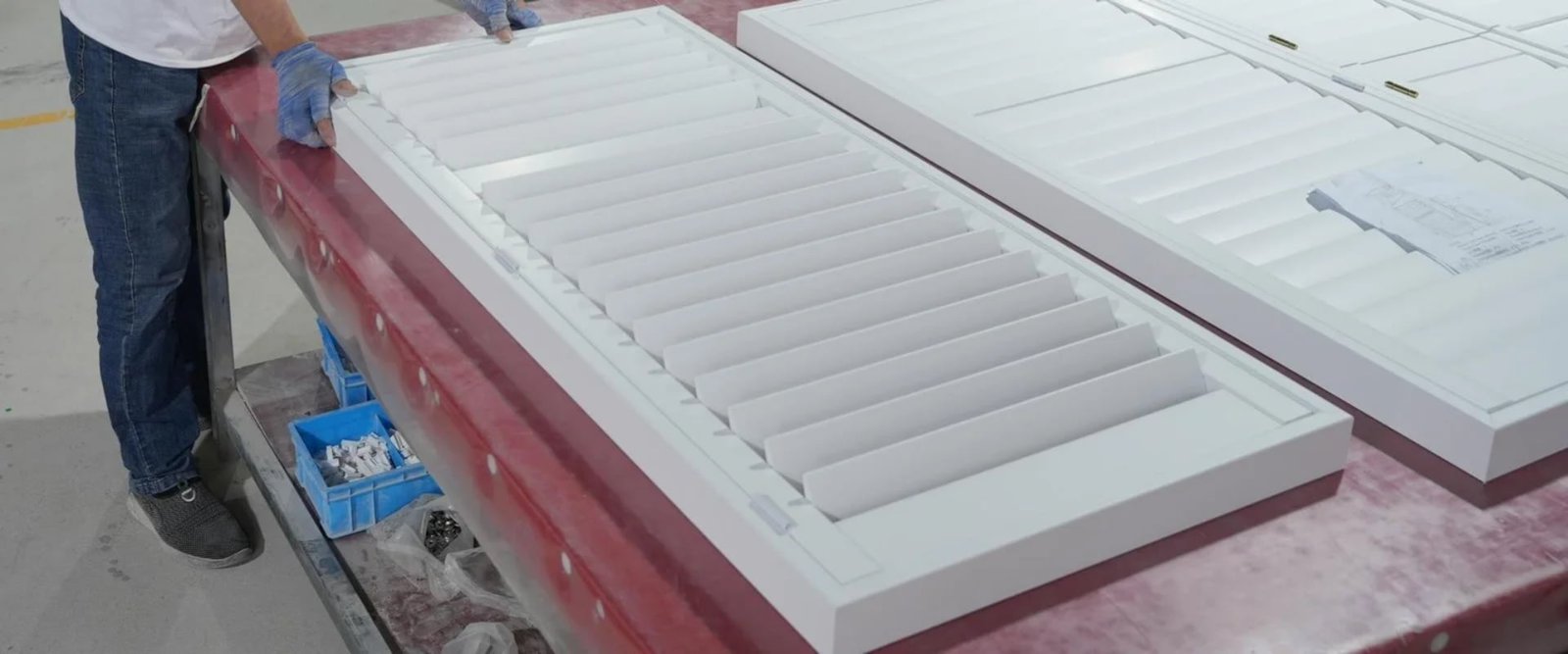
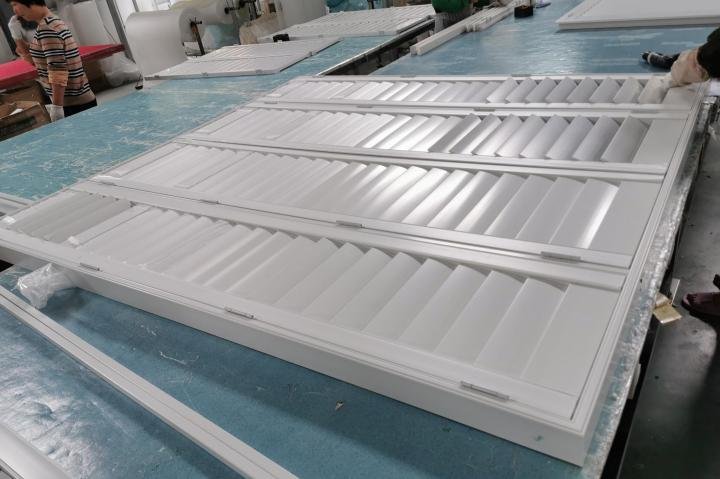 📸 Image: Bright Shutters production floor showing timber and aluminium product lines in parallel. Includes brand signage if available. Conveys full-category manufacturing capability.
Bright Shutters manufactures both timber and aluminium plantation shutters within a single 58,883㎡ production base in Shenzhen, operating 12 dedicated production lines with a 16-person in-house QC team that operates independently from production management. Cumulative output since 2010 exceeds 11 million units across all product categories.
The timber product line covers basswood, ash, and FSC-certified pine, with moisture content verified by cross-sectional sampling on every incoming batch. The aluminium product line uses 6063-T5 alloy with incoming hardness verification; powder coating is applied by automated electrostatic line at 60–80μm DFT, with batch salt spray testing to ASTM B117 for orders specifying coastal applications.
Both product lines are available for mixed 20GP container orders, with standard plantation shutter lead times of 25–35 days from confirmed purchase order. Bright Shutters operates on an exclusive regional partner model for ANZ — one wholesale account per defined territory — with OEM and custom branding available from the first container.
For a broader overview of working with plantation shutter manufacturers, see our complete guide to plantation shutter manufacturers. Full technical specification sheets for our plantation shutter product range are available on request. For factory audit criteria applicable to both material types, see what to look for in a plantation shutter factory audit.
Frequently Asked Questions
Q: Is aluminium more expensive than timber plantation shutters from a factory-direct supplier?
A: At factory-direct pricing, aluminium plantation shutters typically carry a 10–15% premium over equivalent timber (basswood or FSC pine) specifications. The premium is driven by the precision gear-rod tilt mechanism and 6063-T5 alloy cost, partially offset by lower painting labour (powder coating is more automated than multi-coat brush or spray painting). For 89mm louvre sizes, the gap narrows as timber material cost increases with louvre width. Mixed-container orders combining both material types are available from a single 20GP container minimum.
Q: Which material is better suited to Australian coastal or high-humidity environments?
A: For most coastal applications, aluminium with verified 60–80μm powder coating and ASTM B117 1,000-hour salt spray compliance is the more practical long-term specification — it requires no surface maintenance and is not affected by humidity cycling. However, aluminium shutters in sustained winds above approximately 14 m/s produce audible metallic vibration between louvres and frame; for coastal or high-rise bedrooms, this is a real operational characteristic to account for in specifications. Timber in annual average humidity above 70% with seasonal swings greater than 30% RH carries a measurable risk of minor warping over a 10-year period — not a defect but a natural wood behaviour. For high-humidity environments (North Queensland, Northern Territory), aluminium or PVC are more reliable long-term choices.
Q: Can aluminium plantation shutters be repainted on-site after installation?
A: No — not practically. Powder-coated aluminium cannot be refinished on-site to match the original coating appearance. Any colour change requires returning the product to a factory with a full powder coating facility (sandblast, re-coat, cure). The cost is typically 40–60% of original product price. Timber plantation shutters, by contrast, can be sanded and repainted on-site with standard trade paints, making them the correct specification for projects that anticipate future colour changes (rental properties, heritage refurbishments, commercial spaces with regular refit cycles).
Q: How do timber and aluminium shutters compare for large window spans above 1,800mm?
A: Both materials require a mid-rail (horizontal dividing bar) for spans above 1,800mm to prevent louvre deflection under self-weight. Within this constraint, aluminium has an advantage: panel weight is 30–40% lower than equivalent ash timber, reducing cumulative hinge load across a multi-panel installation. For 2,000–2,400mm spans, specify aluminium with standard hinges or timber with stainless steel 304 hinges rated at ≥6 kg/pair (not standard zinc-alloy hardware). For spans above 2,400mm, a structural review of the mid-rail and frame specification is recommended regardless of material.
Q: What warranty differences should I expect between timber and aluminium plantation shutters?
A: Bright Shutters offers a lifetime structural warranty on aluminium plantation shutters (covering the gear-rod mechanism and frame integrity) and a 5-year finish warranty on powder coating under standard (non-coastal) conditions. Timber plantation shutters carry a 5-year structural warranty and a 3-year finish warranty. Both warranties require installation according to provided guidelines and exclude damage from modified installations, extreme environmental exposure beyond specification (e.g., direct water contact for timber products), or physical damage post-installation. Warranty claims are handled via credit notes or replacement components included in subsequent orders.
Q: What is the minimum order for mixed timber and aluminium plantation shutter orders?
A: Bright Shutters' standard minimum is one 20GP container, which can be mixed across timber species, aluminium, and louvre sizes within a single order. A typical 20GP mixed plantation shutter order carries approximately 200–350 sets depending on size configuration. Window shades and venetian blinds can be added to the same container to reach the minimum across product lines if the full container volume cannot be filled with plantation shutters alone. Sample sets for specification and client presentation are available prior to a first container commitment.
Talk to Our Production Team Before You Specify
Bright Shutters' production team specifies wood and aluminium plantation shutters across ANZ wholesale accounts daily. Before you commit to a material for your next project or product line, speak with us directly — we can provide sample sets, technical specification sheets, and lead time confirmation for your specific requirements.