When ANZ wholesale buyers source plantation shutters from China, the decision that most determines long-term supply reliability is not price — it is which manufacturing variables to audit before placing a first container order. A plantation shutter factory in China may quote identically on paper but diverge significantly in the six production-level practices that predict whether product will arrive dimensionally stable, maintain appearance over a 10-year ANZ installation cycle, and perform consistently across repeat orders. This guide covers each of those six variables, what to ask during a factory audit, and what documentation to require before signing a purchase order.
Why Factory Evaluation Matters More Than Price Comparison
The Gap Between Quoted Price and Delivered Quality
Price comparison between Chinese plantation shutter factories is straightforward. Quality comparison is not. Two factories quoting the same FOB price for a 20GP container of basswood plantation shutters may be using different PVC compound specifications for hardware, different kiln-drying protocols for timber, different in-line inspection frequencies, and different packaging standards — none of which appears on the product specification sheet or sample.
The consequences of these differences do not appear at factory QC. They appear 12–18 months after installation, when panels begin warping, louvre closures develop light gaps, or powder-coated hardware starts showing corrosion in coastal environments. By that point, the container has long cleared customs, the warranty claim conversation is difficult, and the reputational cost to the ANZ wholesale buyer has already been absorbed.
What Goes Wrong — and When
The failure modes that generate the most costly ANZ wholesale callbacks are not random. They follow predictable patterns tied to specific manufacturing shortcuts: timber dried too fast, PVC compounded with insufficient stabiliser, extrusion tolerances not monitored closely enough, and packaging not validated for the Pacific freight environment. Each of these can be identified — and effectively eliminated — at the factory audit stage, before any production begins. For a broader overview of the supplier landscape, see our guide to evaluating plantation shutter manufacturers.
The Six Manufacturing Variables to Audit Before You Order
Factory audits for plantation shutters from China tend to focus on the visible: facility size, equipment age, sample quality, and certification documents. The six variables below are the ones that actually determine production reliability — and the ones most commonly omitted from standard audit checklists.
Variable 1 — PVC Compound Specification
PVC plantation shutters and PVC-profile components in timber shutters both depend on the quality of the PVC compound used in extrusion. The single most consequential compound variable for ANZ buyers is titanium dioxide (TiO₂) loading — the stabiliser that governs UV resistance and anti-yellowing performance.
The standard TiO₂ loading for ANZ-market PVC shutters should be ≥10 phr (parts per hundred resin). Some factories reduce this to 4–6 phr to cut material cost. The difference is invisible at the point of manufacture and invisible on arrival. It becomes visible at approximately 12–18 months post-installation, when panels in high-UV environments — northern Queensland, Western Australia, the NT — begin to yellow. Australian solar UV intensity is more than 40% higher than European levels; a compound specification adequate for the European market will degrade significantly faster in ANZ conditions.
To verify compound specification, request that the factory provide a Thermogravimetric Analysis (TGA) report from their PVC compound supplier for every production batch. TGA testing quantifies TiO₂ loading directly and cannot be falsified after the fact. For UV performance validation of finished goods, request an ASTM G154 accelerated weathering test report from a third-party laboratory — SGS, Intertek, or Bureau Veritas are the accepted testing bodies. The ASTM G154 cycle 1 protocol (UV-A 340nm lamp, 60°C irradiation/4h + 50°C condensation/4h) is the relevant test method; acceptable performance for ANZ conditions is a colour change of ΔE (CIE 2000) ≤1.5 after 500 hours. Reports should reference the specific compound batch number to enable traceability across future orders.
Variable 2 — Timber Moisture Management
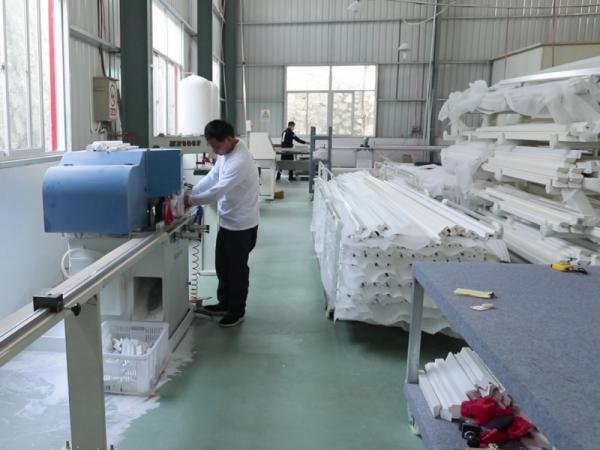 📸 Image: Close-up of in-line QC measurement on extrusion line or finished timber components. Supports the PVC tolerance and timber QC narrative.
Timber moisture content at the point of CNC machining — the accepted range is 8–12% — is one of the most commonly cited quality parameters, and one of the most commonly misrepresented. The problem is not factories lying about moisture content; it is that the measurement method used in most factory IQC protocols does not detect the moisture condition that causes post-shipment warping.
A pin-type resistance moisture meter reads at approximately 5–8mm depth — the surface layer of the timber. When kiln drying is conducted too rapidly to meet production schedules, the exterior surface dries and locks dimensionally while the core retains moisture at 14–16%. This condition — case hardening — passes a pin meter reading as compliant. The core moisture is not detected.
The failure mechanism unfolds during the three-week Pacific crossing. Container temperature cycles between tropical air masses and sub-Antarctic cold fronts; internal humidity gradients cause case-hardened timber to continue drying unevenly. Internal stress releases progressively, and panels that measured acceptable at the factory arrive warped. The failure pattern is characteristically non-random: middle panels in a batch warp while edge panels remain straight — leading buyers to suspect inconsistent material rather than a systematic kiln process failure.
Per ASTM D4442, Method B (the oven-dry method: 105°C for 24 hours, moisture calculated by weight loss), core and surface moisture can both be accurately measured by cross-sectional sampling — cutting the timber through and testing each zone separately. The surface-to-core moisture differential should not exceed 2% on compliant timber. Any factory using only pin meters for IQC is not detecting case hardening. Require evidence of cross-sectional oven-dry sampling per incoming batch. For a full technical comparison of how timber and aluminium plantation shutters differ in manufacturing risk profile, see our breakdown of wood versus aluminium shutter manufacturing.
Variable 3 — PVC Extrusion Tolerance Control
For PVC plantation shutter louvres, wall thickness consistency across the extruded profile is a quality variable with a delayed failure signature. The design specification is typically a wall thickness tolerance of ±0.1mm. When extrusion lines drift — through tooling wear, temperature variation, or insufficient monitoring — the actual tolerance can expand to ±0.3mm.
This 0.2mm variance does not affect visual appearance and passes standard finished goods inspection. The failure emerges 12–18 months post-installation. Louvres undergo daily thermal cycling between outdoor ambient temperatures and climate-controlled interiors; cumulative dimensional movement causes the closure gap between adjacent louvres to widen from a designed 0.2mm to 0.5mm or more. The result is visible light leakage at the mid-panel when louvres are fully closed — a callback that is difficult to diagnose remotely and expensive to rectify on-site.
The preventive control is in-line wall thickness monitoring at high frequency. A production protocol that checks extrusion dimensions every four hours is insufficient to catch gradual tooling drift before it affects an entire batch run. Ask specifically what the in-line inspection frequency is and what the corrective action protocol is when readings drift toward the tolerance boundary. Factories with robust extrusion QC will measure at 30-minute intervals or better, with documented corrective action records.
Variable 4 — Sample-to-Production Quality Consistency
The most universal quality risk in China sourcing — across all product categories, not just plantation shutters — is the gap between a hand-finished development sample and a production-line batch. Development samples are built carefully, often by senior craftspeople, using selected materials. Production batches are built to cycle time and output targets.
This gap is not dishonesty; it is a structural feature of how sample development and mass production operate differently. It can be managed, but it will not manage itself. Three controls are required:
First, require a Pre-Production Sample (PPS) — a unit produced using production-line materials, production-line equipment, and production-line processes — before approving any large batch. A PPS is different from the original development sample; it is what production will actually look like. Approve the PPS, not the development sample.
Second, specify quality allowances explicitly in the purchase contract: a written table defining acceptable dimensional variance, colour tolerance (ΔE limit), and cosmetic defect classification (critical, major, minor). Without a contractual reference, quality disputes at delivery have no objective baseline.
Third, schedule an In-Process Inspection (IPI) at approximately 50% production completion. At the halfway point, quality problems are diagnosable and correctable within the original lead time. Discovering the same problems at the pre-shipment stage leaves no time to rectify without delaying the shipment. Most factories will accommodate an IPI; a factory that declines should be treated as a risk signal.
Variable 5 — Pre-Shipment Inspection Timing
Pre-shipment inspection (PSI) is standard practice for China-sourced goods. The timing of PSI, however, is frequently misunderstood — and when timed incorrectly, it misses a significant category of damage.
The common error is conducting PSI at the finished-goods stage, before packaging. This captures manufacturing defects but misses the 2–4% of units that are damaged during the packing process itself — knocked, compressed, scratched, or incorrectly stacked during loading into export cartons and onto pallets. A PSI report showing "conforming" on pre-pack goods provides no assurance about the condition of goods as loaded.
The correct PSI protocol is: all goods fully packed into export cartons → 10% open-box check on randomly selected cartons → final PSI report issued. This sequence verifies both product quality and the integrity of the packing process. It adds 4–8 hours to the inspection timeline but eliminates the most common source of hidden transit damage claims. When engaging a third-party inspector (SGS, QIMA, Intertek), confirm explicitly that the PSI scope includes post-pack open-box sampling, not only pre-pack finished goods assessment.
Variable 6 — Export Packaging and Container Moisture Control
The Pacific freight route from Shenzhen to ANZ ports subjects cargo to significant temperature cycling. A container loaded at 30°C and 70% relative humidity in Shenzhen passes through the tropics and then into sub-Antarctic air on the southern route; the differential between tropical air inside the container and the cold steel container walls creates condensation on the internal steel surfaces. This condensation runs down the walls and pools at the base of the container, where bottom-tier cargo — frequently the heaviest items — absorbs it.
For timber plantation shutters, container condensation is a direct mould risk. For PVC and aluminium components, it accelerates corrosion of uncoated hardware. The preventive measure is desiccant placement — silica gel bags distributed throughout the cargo load, not only at the base. The effective ratio is 1kg of silica gel (coarse granule type, for maximum surface area) per 2m³ of container volume. This is not an optional measure for the ANZ route; it is a baseline practice. Ask the factory to show you their standard export packing specification and verify desiccant placement is documented.
Separately, verify that the factory's export carton and packing configuration has been validated under ISTA 2A testing — the International Safe Transit Association standard that simulates the vibration (4–100Hz random vibration, sustained) and shock (free-fall drop based on package weight) conditions of actual sea freight logistics. Any modification to carton size, internal cushioning, or pallet configuration should trigger a revalidation. A factory that cannot provide ISTA 2A validation documentation for its current packaging spec is operating on untested packing designs.
Audit Checklist Summary
| Manufacturing Variable | What to Ask | What to Verify |
|---|---|---|
| PVC compound specification | What is the TiO₂ loading (phr) in your ANZ-spec PVC compound? | TGA report from compound supplier; ASTM G154 third-party UV test report (ΔE ≤1.5 at 500h) |
| Timber moisture management | How do you verify incoming timber moisture content? | Cross-sectional oven-dry test records (ASTM D4442 Method B); surface-to-core differential ≤2% |
| PVC extrusion tolerance | What is your in-line wall thickness inspection frequency? | Inspection logs showing ≤30-minute measurement intervals; corrective action records |
| Sample-to-production quality | Can you provide a Pre-Production Sample before batch approval? | Signed PPS approval process; production quality allowance table in contract; IPI access at 50% completion |
| Pre-shipment inspection | Is your PSI conducted before or after packing? | PSI protocol showing post-pack open-box sampling of ≥10% of cartons |
| Export packaging | What desiccant loading do you use for ANZ-route containers? | Packing spec showing ≥1kg silica gel per 2m³, distributed across cargo layers; ISTA 2A validation documentation |
How Bright Shutters Addresses Each Variable
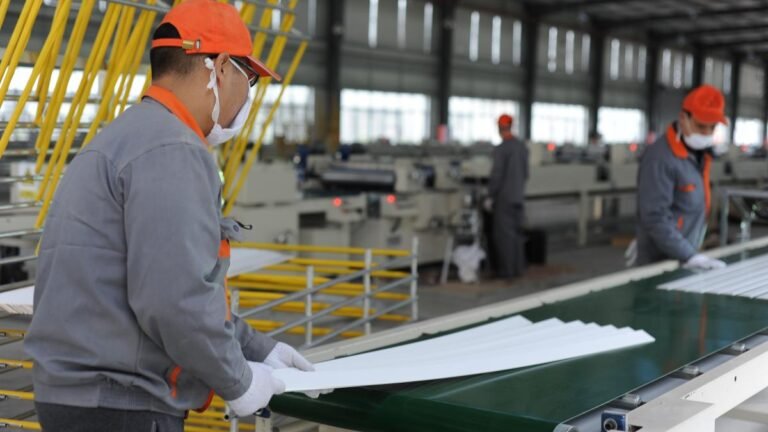
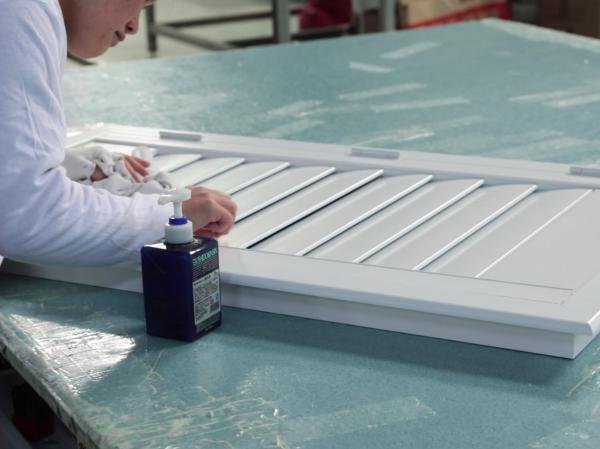 📸 Image: QC team conducting finished goods inspection on plantation shutter panels. Shows independent QC function, measuring instruments, and finished product.
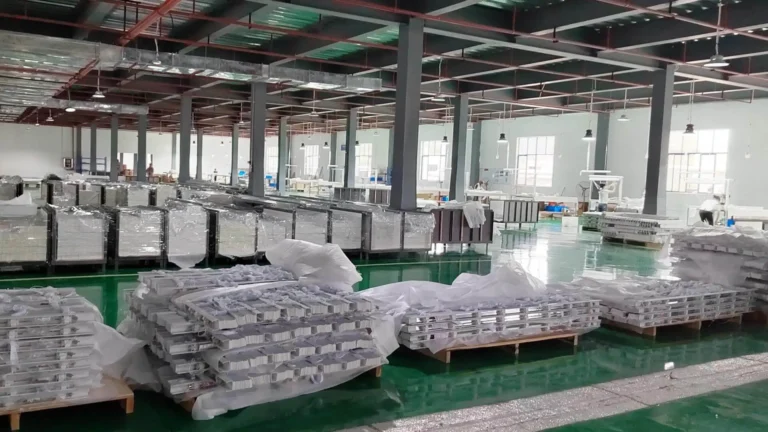
Bright Shutters operates from a 58,883㎡ production facility in Shenzhen, with 12 dedicated production lines and a 16-person in-house QC team that reports to the Quality Director independently of the production management chain. Cumulative output since 2010 exceeds 11 million sets across plantation shutters, venetian blinds, and window shades.
On PVC compound: ANZ-specification orders use a PVC compound with TiO₂ loading ≥10 phr, with TGA verification required from the compound supplier on every incoming batch. On timber moisture: incoming lumber is subject to cross-sectional oven-dry sampling per ASTM D4442 Method B on every batch, in addition to pin-meter surface readings; surface-to-core differentials exceeding 2% are rejected. On extrusion tolerance: wall thickness is measured at 30-minute intervals on all active extrusion lines, with documented corrective action triggered at ±0.15mm — before the tolerance boundary is reached.
Pre-Production Samples are standard practice for all new account specifications and are produced using production-line materials and processes. Bright Shutters welcomes In-Process Inspection access for all orders; progress tracking is available throughout production. Pre-shipment inspection follows a post-pack protocol: 10% open-box random sampling after all goods are packed, before container loading. Export packaging for ANZ routes includes silica gel desiccant distributed at 1kg per 2m³ cargo volume, and Bright Shutters' current export carton configuration is ISTA 2A validated.
Bright Shutters' ANZ partnership model operates on regional exclusivity — one wholesale account per defined territory — with OEM/ODM branding available from the first container. Explore our plantation shutter product range for full specifications across timber, PVC, and aluminium product lines.
Frequently Asked Questions
Q1: What documents should a plantation shutter factory in China be able to provide?
A: A reliable plantation shutter factory should be able to provide, on request: FSC Chain of Custody certificate (for timber products, verifiable at info.fsc.org); REACH SVHC compliance declaration for PVC and metal components; ASTM G154 UV ageing test report for PVC products targeting ANZ markets; material test certificates (MTC) for aluminium alloy specifying temper state and hardness; ISTA 2A packaging validation documentation; and third-party pre-shipment inspection reports from previous orders. The absence of any of these — or a reluctance to provide them — should be treated as an audit flag, not a minor administrative issue.
Q2: How do I verify timber moisture content before a container ships?
A: The only reliable method for detecting case-hardened timber is cross-sectional oven-dry testing per ASTM D4442 Method B — the timber is cut through, and each zone (surface and core) is measured separately by weight loss after drying at 105°C for 24 hours. A pin-type resistance moisture meter reads only the surface layer (5–8mm depth) and will return an acceptable reading on case-hardened timber where the core moisture may be 14% or higher. Request that the factory provide oven-dry test records for each incoming lumber batch, showing surface-to-core differential. A differential exceeding 2% indicates case hardening risk and should trigger batch rejection or extended re-drying before production proceeds.
Q3: Why does my sample look different from my production run?
A: Sample-to-production quality drift is a structural feature of manufacturing, not specific to China sourcing — but it is more pronounced when buyers approve development samples (hand-built, selected materials) rather than Pre-Production Samples (PPS). A PPS is produced using the same production-line equipment, materials, and processes that will be used for the full batch. Require a signed PPS approval as a contractual condition before batch production begins. Additionally, include a production quality allowance table in your purchase contract — a written specification of acceptable dimensional variance, colour tolerance (ΔE limit), and cosmetic defect classifications. Without a contractual reference standard, quality disputes have no objective basis for resolution.
Q4: What is the correct timing for pre-shipment inspection of plantation shutters?
A: Pre-shipment inspection should always be conducted after all goods are fully packed into export cartons, not before packing. Pre-pack inspection misses damage caused by the packing process itself — stacking loads, carton compression, and handling during container loading — which typically accounts for 2–4% of units in a container. The correct protocol is: 100% of goods packed → third-party inspector conducts a random open-box check on a minimum of 10% of cartons → PSI report issued. When engaging SGS, QIMA, Intertek, or similar, confirm explicitly in the inspection brief that scope includes post-pack open-box sampling, not only visual assessment of pre-packed finished goods.
Q5: Does Bright Shutters offer in-factory inspection access for ANZ buyers?
A: Yes. Bright Shutters welcomes third-party In-Process Inspection (IPI) access at any stage of production, and in particular at the 50% completion milestone — the point at which quality issues are still correctable within the original lead time. First-time buyers are also welcome to visit the Shenzhen facility for a factory audit prior to placing a first container order. Production progress updates are available throughout the manufacturing cycle. Sample sets for pre-order specification purposes are available with a 3–7 day turnaround.
Q6: What is the minimum order for a first plantation shutter container from China?
A: Bright Shutters' standard minimum is one 20-foot general purpose container (20GP). All three product lines — plantation shutters (timber, PVC, and aluminium), venetian blinds, and window shades — can be combined in a single container to reach the minimum. A standard 20GP mixed plantation shutter order typically carries 200–350 sets depending on louvre size and panel dimensions. For buyers who cannot fill a full container with plantation shutters alone, adding venetian blinds or roller shades to the order is the standard approach to reach the container minimum without over-committing to any single product.
Talk to Bright Shutters Before Your Next China Sourcing Decision
If you are evaluating plantation shutter factories in China for a first container order or a supplier switch, the six variables in this guide are the right starting point — but the easiest way to assess them is to ask us directly. Bright Shutters' production team fields sourcing qualification questions from ANZ wholesale buyers regularly and can provide PPS samples, third-party test documentation, and lead time confirmation for your specific product requirements.
Contact us directly to request a sample set or discuss your sourcing specification: Contact Bright Shutters