
Plantation shutter manufacturers are factories that produce interior hinged or bi-fold louvred panels — in timber, PVC, or aluminium — for residential and commercial window applications. For ANZ wholesale distributors and building materials importers, selecting the right manufacturing source determines not just the purchase price, but the long-term quality consistency, warranty exposure, and lead time reliability of an entire product category. This guide sets out six testable criteria for evaluating plantation shutter manufacturers, drawn from production experience that surfaces the quality variables most buyers do not think to verify until after a problem has arrived on a container.
Why Manufacturer Evaluation Matters More Than Price Comparison
Price per set is the figure most buyers anchor on when comparing plantation shutter manufacturers. It is also the least reliable predictor of total sourcing cost. A manufacturer quoting 15% below market rate on a timber shutter may be compressing costs on kiln drying time, surface sand grit, paint passes, or alloy specification — none of which are visible on a price sheet and most of which do not produce complaints until 12 to 36 months after installation.
The evaluation criteria below are structured around the production variables that most directly determine whether a plantation shutter manufacturer can deliver consistent quality across repeated container orders, not just on initial samples. For a detailed look at how production choices differ by material, see our guide to compare timber and aluminium plantation shutters in detail. For a complete walkthrough of on-site verification, see what to look for during a factory audit in China.
Six Criteria for Evaluating Plantation Shutter Manufacturers
Criterion 1 — Sample Integrity: Pre-Production Samples vs Initial Development Samples
The most common quality disappointment in international plantation shutter sourcing is not a dishonest manufacturer. It is a structural gap between the sample and the batch. Initial development samples — the ones sent to secure an order — are typically hand-finished by a skilled operator working to a specific standard because they know the sample is being evaluated. Batch production is a flow line.
The correct evaluation tool is a Pre-Production Sample (PPS): a small run produced using the actual batch materials, on the actual production equipment, by the actual production operators — before full production begins. A PPS will show the colour consistency, surface quality, and dimensional tolerance of what a container will actually contain. Insist on a PPS clause in your purchase agreement: "Product specifications are governed by the approved Pre-Production Sample. Batch tolerance allowances are as per the attached specification table." Conducting a third-party In-Process Inspection at the 50% production mark adds a further layer — it identifies drift while there is still time to correct it.
Criterion 2 — Timber Moisture Management: Why Surface Readings Are Not Enough
For timber plantation shutter manufacturers, the single most consequential production variable is the moisture content of the lumber at the point of machining. The industry-accepted range is 8–12%, and most manufacturers will confirm compliance. The problem is how compliance is verified.
Pin-type resistance moisture meters — the standard field tool — read at 5–8mm depth. They measure the surface layer only. When a kiln drying cycle is compressed to meet production schedules, the lumber exterior dries and locks dimensionally while the core retains moisture at 14–16%. This condition — called case hardening — passes a pin-meter IQC check because the surface reads within specification. The core moisture is not detected.
The consequence arrives during the three-week Pacific crossing. Inside a sealed container moving through tropical and sub-tropical air masses, temperature cycles drive humidity gradients. Case-hardened timber with a high-moisture core continues releasing internal stress. By the time the container reaches Sydney or Melbourne, middle panels in a batch have warped while edge panels remain straight — a failure pattern that appears random but has a systematic production cause.
Per ASTM D4442 Method B, correct moisture verification uses oven-dry testing (105°C, 24 hours) on cross-sectioned samples. The surface-to-core moisture differential should not exceed 2%. Ask any plantation shutter supplier to describe their incoming timber IQC protocol: if the answer is "we use a moisture meter," that is a surface-only check. The correct answer includes cross-sectional sampling on every incoming batch.
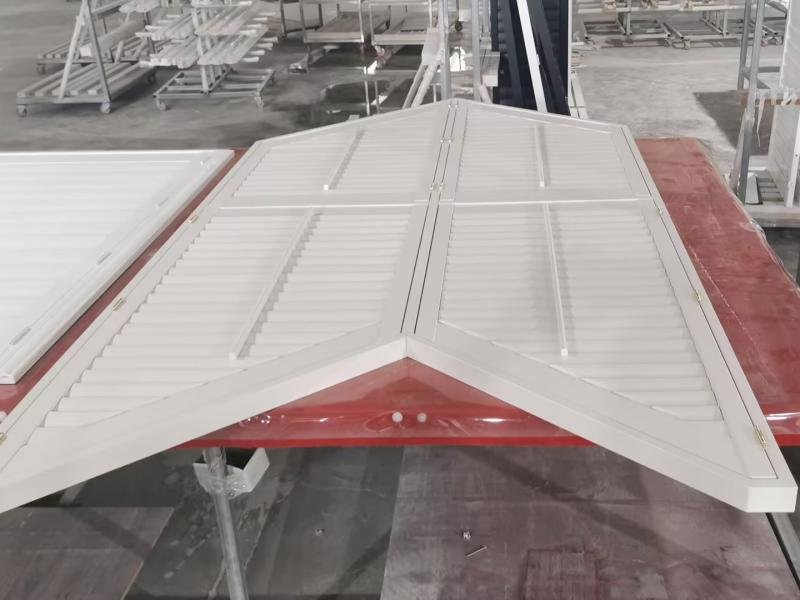 📸 Image: Close-up of a cross-sectioned timber louvre with a moisture probe inserted into the exposed core. Illustrates the difference between surface and core moisture testing.
Criterion 3 — Material Verification: Alloy Temper for Aluminium, Species Certification for Timber
Aluminium shutters: The relevant material specification is the temper state of the 6063 alloy. 6063-T5 (per ASTM B221) provides a yield strength of ≥145 MPa and Vickers hardness of ≥60 HV. 6063-T4 — visually identical, approximately 8% cheaper — provides 110 MPa yield strength. The difference does not appear in the first two to three years of use. It appears in the gear-rod tilt mechanism pivot holes, which experience fatigue wear at 2.3 times the rate in T4 material compared to T5. The result is louvres that no longer hold intermediate positions at years five to seven of daily operation. Verification: request incoming hardness test records (Vickers HV, 5 kgf load) from the manufacturer's QC log.
Timber shutters: Verify the species against the claimed specification. Basswood (椴木) and ash (白蜡木) are commonly specified; lower-cost substitutions with similar appearance but different density and stability characteristics are documented in the trade. For FSC-certified products, verify the certificate directly at info.fsc.org using the supplier's certificate number — confirm it is Active, within its validity period, and covers the product category being purchased.
Criterion 4 — Paint and Finish Adhesion: The Cross-Cut Test Standard
Surface finish is the quality dimension most visible to end consumers and most frequently the subject of warranty claims in the 12–36 month window post-installation. The production variable most directly responsible for finish durability is not the paint system itself — it is the surface preparation before primer.
The industry standard for evaluating paint adhesion on finished timber plantation shutters is the cross-cut test per AS/NZS 1044:1995: a standard blade scores a 1mm-interval grid across the coated surface; adhesive tape is pressed and pulled; the percentage of coating removed is graded 0 (no removal) to 5 (>65% removal). Bright Shutters' internal requirement for finished timber shutters is Grade 0 or 1. Critical procedural note: the test must be conducted at minimum 48 hours after coating application. Coating tested before full cure will return artificially low adhesion results.
When evaluating plantation shutter suppliers, request cross-cut test records from their QC documentation — not just a statement that "we do paint adhesion testing." A grade, a date, and a batch number should be present.
Criterion 5 — QC Stage Timing: Why Pre-Shipment Inspection Must Happen After Packing
Third-party pre-shipment inspection is standard practice in international sourcing. The timing of that inspection is frequently misunderstood, and the misunderstanding creates a consistent blind spot.
The correct timing for a pre-shipment inspection (PSI) is after 100% of the goods have been packed into cartons, but before the container is sealed. The common alternative — scheduling inspection at the Finished Goods QC (FQC) stage, before packing — misses all damage that occurs during the packing process itself: the panel placed louvre-face down on concrete, the corner compressed under stack weight, the surface scratched by a staple gun. These events are entirely invisible to an FQC report conducted before packing.
A complete inspection protocol should run: FQC on finished goods → full packing of all units → 10% carton opening and re-check after packing is complete → final PSI report issued against the post-packing sample. If a manufacturer's PSI process does not include a post-packing check, raise this as a gap in their procedure.
Criterion 6 — Colour Batch Consistency: The D65 Lightbox Requirement
Colour reorder consistency is among the most common friction points between ANZ wholesale buyers and plantation shutter manufacturers. A "Pure White" ordered in March and a "Pure White" restocked in November should be indistinguishable. In practice, the difference between batches is often visible — and the root cause is the lighting environment in which colour acceptance is conducted.
Standard factory fluorescent lighting runs at approximately 4000K colour temperature. Natural daylight is standardised at D65 (6500K). For white and off-white finishes — which represent the majority of plantation shutter orders in the ANZ market — a batch that appears colour-matched under 4000K factory light can show a ΔE (colour difference, CIE 2000 formula) of 2.5–3.0 against the reference sample under D65 conditions. A ΔE above 1.5 is perceptible to the human eye under standard viewing conditions.
The correct QC environment for colour acceptance is a D65 standardised lightbox (6500K, colour rendering index Ra >90). All colour acceptance decisions — both initial sample approval and batch reorder sign-off — should be conducted in this environment against a retained physical master sample. When evaluating plantation shutter suppliers, ask where and under what lighting their colour acceptance is conducted. "We compare to the customer's sample" is not an adequate answer without a standardised light source.
Manufacturer Evaluation Checklist
Use this table as a structured reference when shortlisting plantation shutter manufacturers.
| Evaluation Criterion | What to Ask | Acceptable Answer | Red Flag |
|---|---|---|---|
| Sample type provided | Is this a PPS or a development sample? | Pre-Production Sample from batch materials and equipment | "This is our standard sample" without PPS clarification |
| Timber moisture IQC | How do you test incoming lumber moisture? | Cross-sectional oven-dry sampling, surface-to-core differential ≤2% | "We use a moisture meter" (surface reading only) |
| Aluminium alloy spec | What temper state is your 6063 alloy? Do you have hardness records? | 6063-T5, HV ≥60, incoming batch hardness logs available | Cannot confirm T5; no incoming material test records |
| FSC certification | Can I verify your FSC certificate online? | Active certificate on info.fsc.org covering the product category | Certificate expired or not verifiable online |
| Paint adhesion testing | What is your cross-cut test result, and when is it conducted? | Grade 0–1 per AS/NZS 1044; tested 48h post-coating | No grade recorded; tested immediately after coating |
| PSI timing | When does your pre-shipment inspection occur? | After 100% packing, with post-packing carton opening check | At FQC stage, before packing |
| Colour acceptance | What lighting is used for colour acceptance? | D65 standardised lightbox, Ra >90, master sample retained | Factory fluorescent lighting; no lightbox |
| Lead time reliability | What is your standard lead time and how is it tracked? | Confirmed lead times with production schedule visibility | "Approximately X weeks" without tracking mechanism |
| QC team independence | Does your QC team report to production or independently? | QC team reports independently from production management | QC managed by production department |
What Plantation Shutter Manufacturers in China Offer ANZ Buyers
China accounts for the majority of global plantation shutter manufacturing output, and the ANZ market has sourced from Chinese manufacturers for over two decades. The primary advantages are material access (basswood, ash, and FSC-certified pine at competitive cost), manufacturing scale (automated CNC and coating lines that produce consistent dimensional tolerances), and lead times that, for a well-run Shenzhen-based factory, can reach port-to-port delivery within four weeks of order confirmation.
The key variable within the Chinese manufacturing landscape is the gap between capable and incapable producers. The criteria above are not theoretical — they reflect the actual production choices that separate manufacturers who deliver consistent results across multiple container orders from those who deliver well on initial samples and struggle on repeats. ANZ buyers sourcing plantation shutters from China should apply these criteria at initial supplier evaluation, not after the first quality problem.
Bright Shutters: Factory-Direct Plantation Shutters for ANZ Wholesale Partners
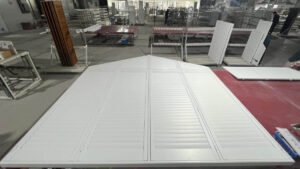
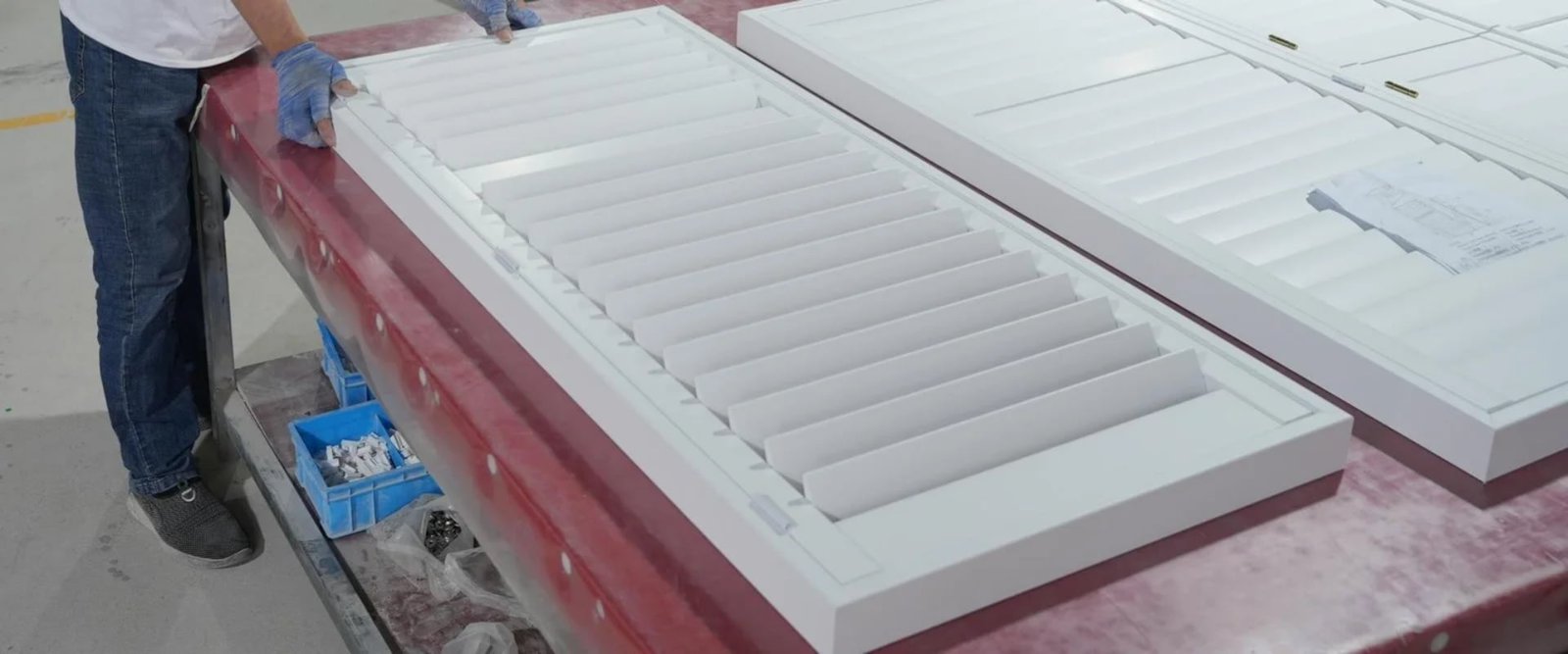
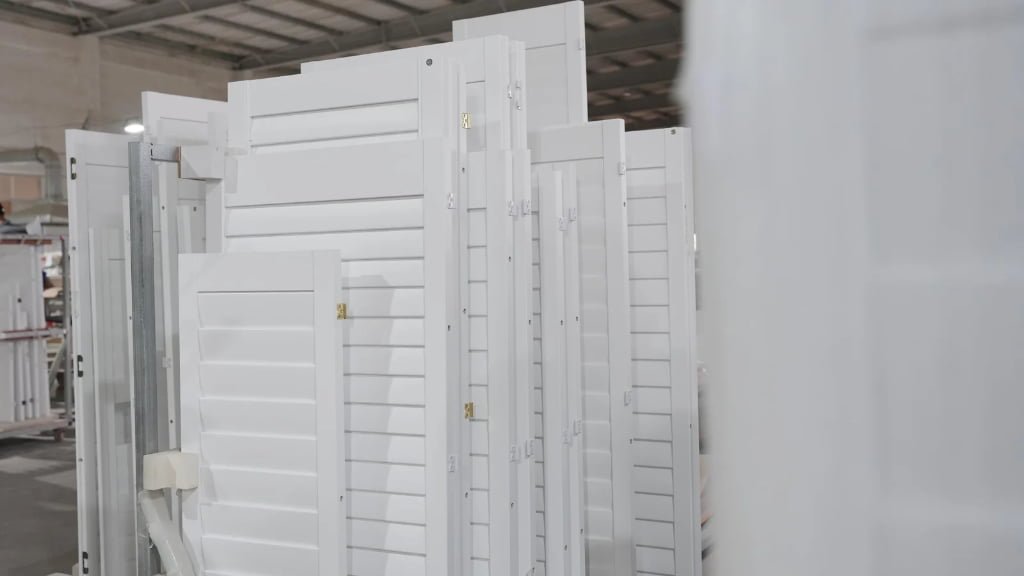
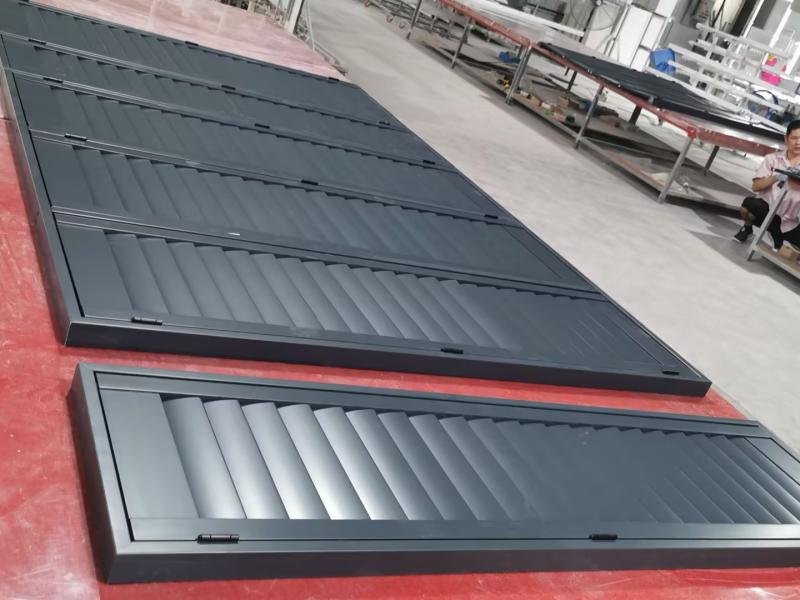 📸 Image: Bright Shutters production floor overview with plantation shutter panels visible at multiple production stages. Brand signage included if available.
Bright Shutters operates from a 58,883㎡ production facility in Shenzhen, with 12 dedicated production lines and a 16-person in-house QC team that reports independently from production management. Cumulative output since 2010 exceeds 11 million sets across plantation shutters, venetian blinds, and window shades.
The plantation shutter range covers timber (basswood, ash, and FSC-certified pine), PVC (200+ extruded cross-section profiles, produced in-house on 50+ extrusion lines), and 6063-T5 aluminium with a gear-tilt mechanism. All three materials are available for mixed 20GP container orders. Standard lead time for plantation shutters is 25–35 days from confirmed purchase order.
Each of the evaluation criteria described in this guide corresponds to a documented process within Bright Shutters' production and QC system: cross-sectional moisture sampling on incoming timber, incoming hardness verification on aluminium profiles, post-packing pre-shipment inspection, D65 lightbox colour acceptance, and retained master samples for reorder colour consistency.
Bright Shutters operates on an exclusive regional partner model for Australia and New Zealand — one authorised wholesale account per defined territory — with full OEM and ODM branding available from the first container. Sampling lead time is 3–7 days. View our plantation shutter product range for full specifications.
Frequently Asked Questions
Q: What is the difference between a plantation shutter manufacturer and a plantation shutter supplier?
A: A plantation shutter manufacturer produces shutters in-house — from raw material processing through finished goods. A supplier may be a trading company that sources from multiple manufacturers without owning production facilities. For ANZ wholesale buyers, the distinction matters for quality control: a direct manufacturer can provide batch-level production records, material certificates, and QC documentation; a trading company typically cannot. When evaluating a source, ask directly whether they own their production facility and request a factory audit or video walkthrough of the manufacturing line.
Q: How do I verify that a plantation shutter manufacturer in China is using FSC-certified timber?
A: FSC Chain of Custody certification can be verified directly at info.fsc.org using the supplier's certificate number. Check three things: that the certificate status is Active (not Suspended or Expired), that the validity period covers your current order date, and that the product scope listed on the certificate includes plantation shutters or the relevant timber product category. Note that FSC certificates require annual renewal; a certificate that was valid 18 months ago may not be current. Request the certificate number before ordering, not after.
Q: Should I accept an initial development sample as the quality benchmark for a container order?
A: Not as your only reference. Initial development samples are typically produced by experienced operators working to a specific standard because they know the sample is under evaluation. Batch production runs on a flow line at normal production pace. The correct benchmark is a Pre-Production Sample (PPS) — a small run using batch materials, on batch equipment, produced under normal production conditions. Insist on PPS approval before full production begins, and include a clause in your purchase agreement stating that batch specifications are governed by the approved PPS, not the development sample.
Q: What lead times should ANZ buyers expect from plantation shutter manufacturers in China?
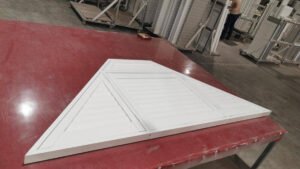
A: For a Shenzhen-based manufacturer with direct port access, a realistic door-to-door lead time for a standard 20GP container order is 25–35 days production plus approximately 12–16 days sea freight to major ANZ ports (Sydney, Melbourne, Auckland). Total port-to-door from order confirmation: 37–51 days under normal conditions. Lead times extend for custom specifications (non-standard louvre sizes, custom hardware, complex arched or angled panels) and during peak production periods. Always request a written production schedule with milestone dates, not a single quoted lead time figure.
Q: How many sets fit in a 20GP container of plantation shutters?
A: This depends on panel size configuration and product mix. A typical 20GP container of standard-size plantation shutters (predominantly 600–900mm wide × 1,200–2,100mm high panels) carries approximately 200–350 sets. Narrower panels allow higher unit counts; larger panels reduce them. Window shades and venetian blinds can be combined in the same container to fill remaining volume and reach minimum order requirements. Request a packing plan from the manufacturer during quotation — a credible manufacturer can provide this before production begins.
Q: What certifications should plantation shutter manufacturers hold for the ANZ market?
A: The most relevant certifications for ANZ wholesale sourcing are: FSC Chain of Custody (for timber products sold under an FSC claim), OEKO-TEX Standard 100 (for fabric components in shades or soft treatments), and compliance documentation for Australian Consumer Law regarding corded window covering safety (ACCC Consumer Protection Notice 2014 No. 7) if products include operational cords. Plantation shutters themselves — being operated by hand tilt rod or gear mechanism rather than loose cords — typically sit outside the cord safety compliance requirements, but this should be confirmed against the specific product configuration being sourced.
Q: What is the minimum order quantity for plantation shutters from a China manufacturer?
A: For most direct plantation shutter manufacturers in China, the standard minimum is one 20-foot container (20GP). At Bright Shutters, all three product lines — plantation shutters, venetian blinds, and window shades — can be combined within a single 20GP to reach the container minimum. This allows buyers to trial or restock across categories without needing a full container of any single product type. Sampling prior to a first container order is available with a 3–7 day lead time.
Ready to Evaluate Us? Contact the Bright Shutters Team
If you are currently shortlisting plantation shutter manufacturers for your ANZ wholesale business, we are straightforward to evaluate against the criteria in this guide. We can provide Pre-Production Samples, incoming material test records, QC documentation, and a production schedule for your specific specification — before you commit to a container.
Contact Bright Shutters directly to request a sample set or discuss your sourcing requirements.