
One of the most common sources of error in plantation shutter orders — at every level of the supply chain — is sizing. Incorrect dimensions result in panels that cannot be installed, customers who cannot take delivery, and factories that cannot process refunds on custom-made product. As a manufacturer shipping to the Australian and New Zealand markets for over 15 years, we have seen every variation of this problem.
This guide exists because we believe that sizing errors are almost entirely preventable. The information below covers the standard window dimensions in the AU/NZ residential market, how louvre width interacts with panel size, how to measure correctly, and what to communicate to your factory to get the panels you actually need.
How Plantation Shutters Are Measured
Before discussing standard sizes, it is important to establish the measurement convention, because Australia uses a different default from some other markets.
In Australia and New Zealand, shutters are measured as width × height (W × H), in millimetres.
A panel described as 600 × 1200 is 600mm wide and 1200mm high. This is the same convention used for window frames in AU/NZ construction — width is always stated first. Confirm this convention explicitly with any factory you order from, because some Chinese manufacturers default to height × width. A transposed measurement on a custom-made panel is a factory-made panel that cannot be installed.
Measurements refer to the panel size, not the rough opening.
The rough opening is the structural opening in the wall. The window frame sits inside the rough opening. The shutter panel sits inside the window frame (for an inside-mount installation) or over the frame (for an outside-mount installation). The panel size you order from the factory is the finished panel dimension — not the rough opening, and not the frame size without deduction.
Standard deductions for inside-mount installation:
For an inside-mount shutter (where the panel sits within the frame reveal), the standard industry deduction is 6mm from each dimension to allow for clearance and hinge movement:
- Panel width = frame opening width minus 6mm
- Panel height = frame opening height minus 6mm
Some manufacturers use a 5mm deduction; others use 8mm. Establish your factory's standard deduction at the sample stage and apply it consistently.
Standard AU/NZ Window Heights
Australian residential windows are not built to a single national standard, but construction practice has produced a set of common heights that account for the majority of residential installations. The following table reflects the window heights we see most frequently in orders from AU/NZ distributors:
| Common window height (rough opening) | Typical frame opening height | Shutter panel height (inside mount, −6mm) |
|---|---|---|
| 900mm | 865mm | 859mm |
| 1,200mm | 1,165mm | 1,159mm |
| 1,500mm | 1,465mm | 1,459mm |
| 1,800mm | 1,765mm | 1,759mm |
| 2,100mm | 2,065mm | 2,059mm |
| 2,400mm | 2,365mm | 2,359mm |
These are the six heights that a distributor building an initial stocked range should prioritise. Windows at 900mm and 1,200mm are dominant in bedrooms and bathrooms. Windows at 1,500mm and 1,800mm are common in living areas and dining rooms. Heights above 2,100mm are more common in double-storey homes and contemporary builds, and often require a mid-rail to maintain structural integrity.
Pro Tip: If you are stocking shutters rather than ordering custom, stock to the panel height rather than the rough opening height. A stocked panel at 1,159mm fits a 1,200mm rough opening window across builders from every state, regardless of their specific frame tolerances. Stocking to rough opening dimensions creates confusion when your customers do their own deductions.
Standard AU/NZ Window Widths
Width varies more than height because window width is more directly influenced by room layout and architectural style. However, single-panel widths are constrained by structural limitations — a single shutter panel wider than 600mm becomes difficult to operate and prone to louvre misalignment under its own weight at standard heights.
Single-panel width range: 300mm to 600mm (finished panel dimension). This is the range within which a single shutter panel is structurally sound and operationally reliable at standard residential heights.
Multi-panel configurations: Windows wider than 600mm are served with two, three, or four panels in a frame. A 1,200mm wide window opening typically takes two 594mm panels (allowing 6mm deduction each and 6mm central gap). A 1,800mm wide opening might take three 591mm panels or two 891mm panels depending on the louvre width and panel height.
The following table covers the most common single-panel widths ordered by AU/NZ distributors:
| Panel width (finished) | Typical application |
|---|---|
| 300–400mm | Narrow windows, sidelights, bathroom highlights |
| 400–500mm | Standard bedroom and bathroom windows |
| 500–600mm | Standard living area windows, sliding door panels |
| 600mm | Maximum recommended single-panel width (standard heights) |
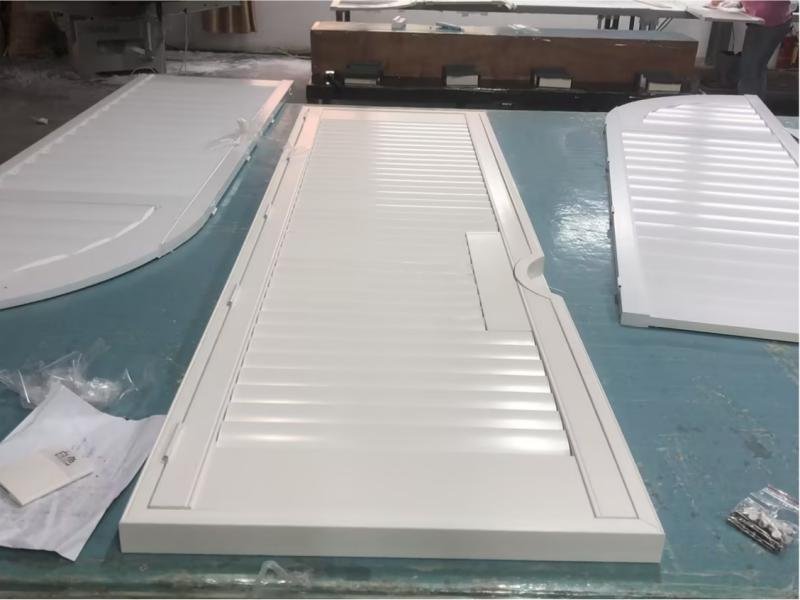
Louvre Width and Its Relationship to Panel Size
Louvre width — the width of each individual blade — is one of the most important specification decisions in a plantation shutter order. It affects the look of the panel, the structural limits of the panel, and the price.
Standard louvre widths available:
| Louvre width | Character | Best application | Max recommended panel height |
|---|---|---|---|
| 47mm | Traditional, heritage | Period homes, heritage renovations | 1,800mm |
| 63mm | Classic, versatile | Most AU residential applications | 2,400mm |
| 76mm | Contemporary | Modern residential, larger windows | 2,700mm |
| 89mm | Architectural, statement | Feature windows, alfresco, commercial | 3,000mm |
How louvre width affects structural limits:
Wider louvres are heavier per unit area, which means a panel with 89mm louvres at 2,400mm height carries significantly more load through the tilt rod and frame than a panel with 63mm louvres at the same height. At our factory, we engineer mid-rail requirements based on louvre width and panel height. The following table gives our standard mid-rail guidelines:
| Louvre width | Mid-rail required above |
|---|---|
| 47mm | 1,800mm panel height |
| 63mm | 2,100mm panel height |
| 76mm | 2,100mm panel height |
| 89mm | 2,400mm panel height |
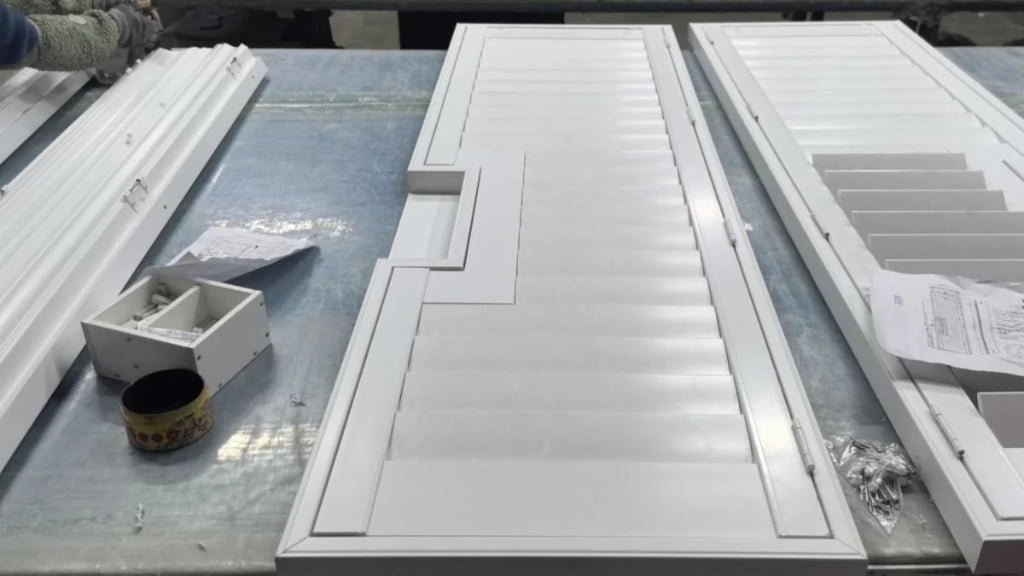
A mid-rail divides the panel horizontally, typically at a visually balanced point (not necessarily geometric centre — we recommend placing the mid-rail at approximately 55% of panel height from the bottom for most installations). The mid-rail allows each half of the panel to operate independently, which is both a structural necessity and a functional feature on tall windows.
Pro Tip: For distributors stocking 63mm louvre panels, the 2,100mm height threshold is the key stocking decision. Panels at or below 2,100mm can be stocked as single panels. Panels above 2,100mm should either be stocked with a mid-rail as standard, or ordered to measure. Stocking single panels above 2,100mm without a mid-rail in 63mm louvre is a returns risk.
Bi-Fold, Sliding, and Shaped Shutters
Standard flat-panel shutters in rectangular openings account for approximately 85% of Australian residential shutter installations. The remaining 15% involves configurations that require specific planning:
Bi-fold shutters fold like a concertina, allowing panels to stack compactly to one side of the opening. Used on wide openings — sliding door replacements, large living area windows — where you want maximum light and clear access when the shutters are open. Individual panels in a bi-fold configuration are typically 400 to 550mm wide; wider individual panels create operational stiffness when folded.
Sliding shutter panels operate on a track system and slide horizontally. Used in openings where a bi-fold stack would obstruct traffic flow. The track adds approximately 25mm to the installation depth requirement — confirm this with your installer before ordering.
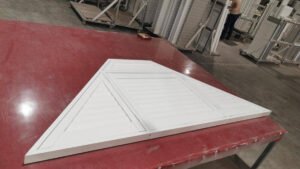
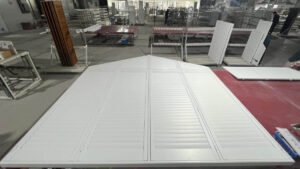
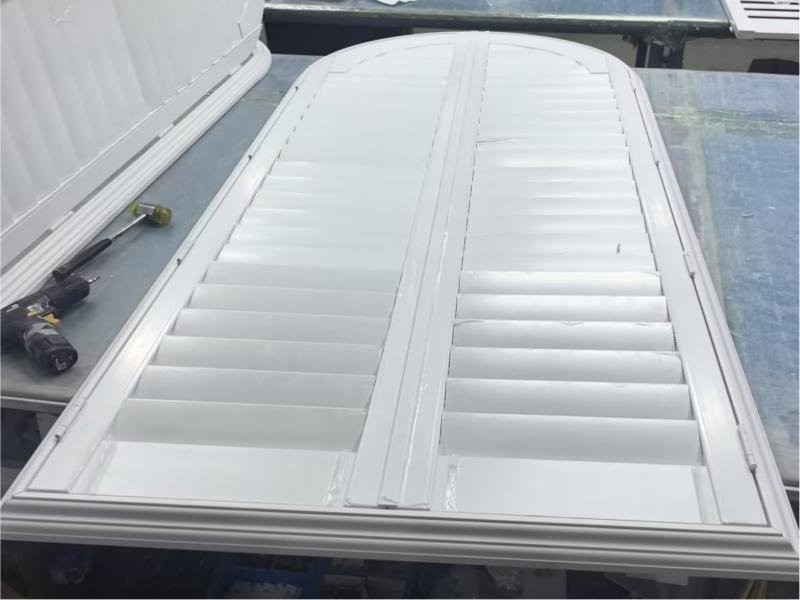
Shaped panels — arched, raked (parallelogram), triangular — are made to measure and cannot be stocked. Lead times for shaped panels at our factory are typically 5 to 8 days longer than standard rectangular panels, and they carry a price premium of 15 to 25% over the equivalent rectangular panel due to the custom tooling and hand-fitting involved. They are worth stocking as a service capability even if you do not hold inventory, because the ability to supply shaped panels locks out competitors who cannot.
Frame Types and Their Impact on Panel Sizing
The frame into which the shutter panel is installed affects both the panel size and the installation depth required. The three common frame types in the AU market:
Z-frame (most common): A three-sided frame — two vertical stiles and one horizontal top rail — that is screwed into the window reveal. The shutter panel sits within this frame on pin hinges. Z-frames are the most installation-efficient frame type; they require a minimum reveal depth of 65mm. Panel size is specified to the Z-frame opening, not the window frame opening.
L-frame: Used when the reveal depth is insufficient for a Z-frame, or for outside-mount installations where the frame sits against the face of the wall or architrave. The L-profile covers the gap between the frame edge and the wall surface. Panel size for an L-frame installation is typically specified to the window opening size, as the frame is surface-mounted.
Solid frame (box frame): A four-sided frame — a complete perimeter box — used for high-end installations and in openings where the wall is not square. More material-intensive than a Z-frame and more expensive, but produces a cleaner finish and is more tolerant of out-of-square openings.
At our factory, we supply Z-frame, L-frame, and solid frame as standard options. Frame material matches the shutter material — wood frames for wood shutters, PVC frames for PVC shutters, aluminium frames for aluminium shutters.
The Sizing Information Your Factory Needs
When placing a shutter order with any factory, provide the following for each line item:
- Panel width × panel height (finished panel dimensions, in millimetres)
- Louvre width (47mm, 63mm, 76mm, or 89mm)
- Material (PVC, basswood, paulownia, aluminium)
- Colour (RAL code, NCS code, or named colour)
- Frame type (Z-frame, L-frame, solid frame, or no frame)
- Hinge side (left or right, viewed from inside the room looking at the window)
- Tilt rod position (centre, offset left, offset right — centre is standard)
- Mid-rail required (yes/no; if yes, specify height from bottom of panel)
- Quantity
Providing all nine data points on your order form eliminates the back-and-forth that extends lead times and creates ambiguity. Factories that receive complete specifications produce more accurate panels faster than factories working from incomplete orders.
Need help specifying your shutter order or building a stocking range for the AU/NZ market? Contact us here — we will send you our order specification template and a recommended stocking range for your volume tier.
Related reading: PVC vs Wood vs Aluminium Plantation Shutters: What AU Distributors Need to Know