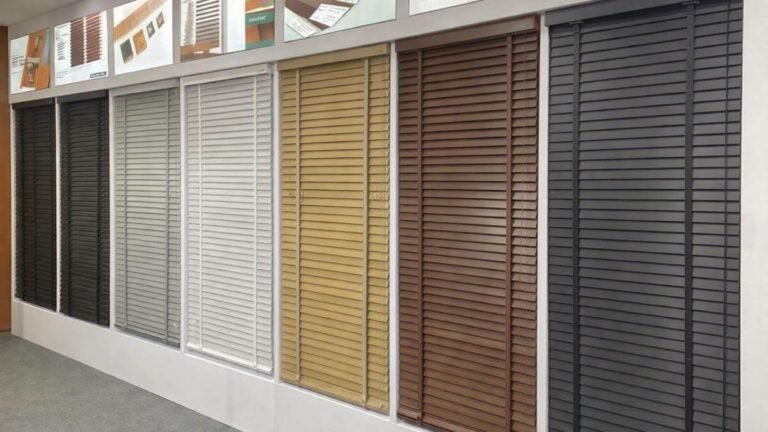
Searching for "plantation shutters manufacturers wholesale" usually means one of two things: you're a distributor trying to add or switch suppliers, or you're an importer trying to work out which factory claims hold up once a container actually lands. Either way, the real question isn't "who makes plantation shutters" — sourcing platforms can answer that in seconds. It's which manufacturer will still be shipping consistent quality on your fortieth container, not just your first sample.
According to industry market research, China remains the world's largest producer of window coverings, accounting for roughly 70% of global production value, with plantation shutters forming a significant share of that output. That scale is exactly why technical due diligence matters more than browsing a supplier directory — at high production volumes, small process variances compound into failures that don't show up until a product has been in service for a year or more.
This guide walks through what wholesale buyers — distributors, window and door companies, building material importers, and commercial project contractors — should actually evaluate before committing to a manufacturer, material by material and process by process.
What "Wholesale-Ready" Actually Means in a Plantation Shutters Factory
Not every factory that lists plantation shutters online is set up to support recurring wholesale volume. A few structural indicators are worth checking before discussing price:
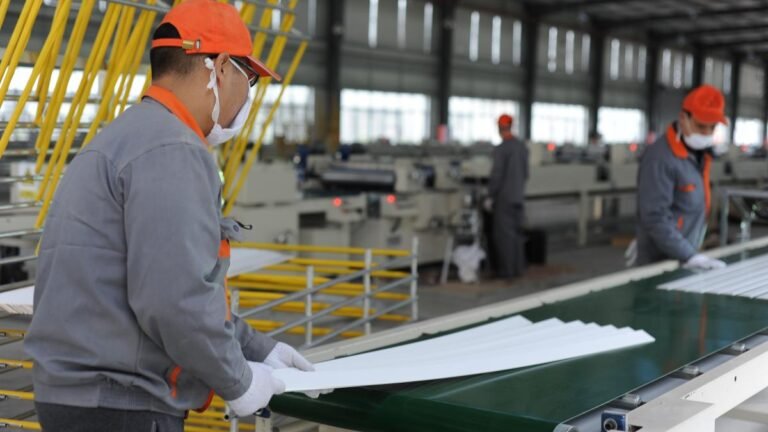
- Dedicated capacity per product line. A factory running plantation shutters, venetian blinds, and window shades on shared general-purpose lines will struggle to hold consistent tolerances across all three. Look for separate, purpose-built lines for each category.
- In-house material processing. Manufacturers that extrude their own PVC profiles and process timber from raw logs — rather than buying semi-finished components from third parties — have direct control over the variables that most often cause field failures: wall thickness, moisture content, and surface treatment.
- An independent QC structure. Quality control should report to a quality director, not to the production manager. A QC team embedded inside the production hierarchy has an inherent incentive to pass borderline product to hit shipping deadlines.
- CNC and automated coating capability. Multiple CNC centres and automated, conveyor-fed coating lines with temperature-controlled spraying indicate a factory can hold tighter dimensional and finish tolerances than manual-spray operations typically achieve.
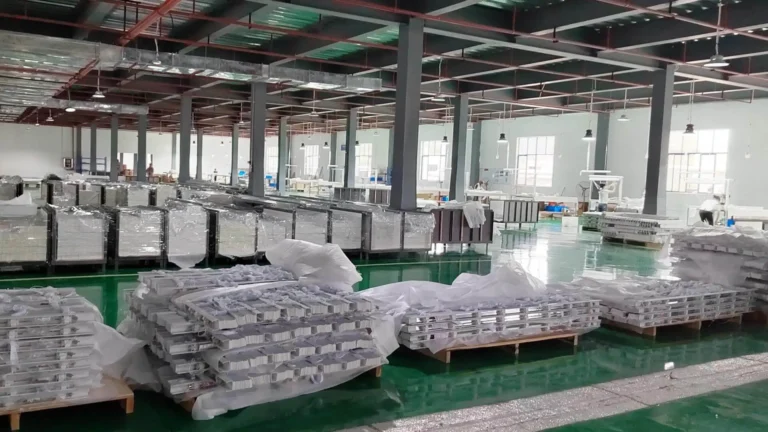
A factory operating at meaningful scale — tens of thousands of square metres of automated production space, several hundred staff, and a six-figure annual unit capacity — isn't automatically the right partner, but it's a reasonable proxy for the kind of process discipline that smaller workshops typically can't sustain order after order.
Material Science Matters More Than the Spec Sheet
Plantation shutters are sold across three core materials — PVC, timber, and aluminium — and each fails in a different, predictable way when manufacturing shortcuts are taken. A wholesale buyer who understands these failure modes can ask sharper questions during factory evaluation than a spec sheet alone will ever prompt.
PVC Plantation Shutters: Wall-Thickness Tolerance and UV Stability
A failure mode common in lower-quality PVC plantation shutters is light leakage at the slat lock-fit after 12–18 months of service, even though the product passed outgoing inspection. The root cause is usually extrusion-line drift: design wall-thickness tolerance is meant to hold at around ±0.1mm, but without frequent in-line monitoring it can widen to ±0.3mm. That 0.2mm variance is invisible at the point of manufacture, but repeated thermal expansion and contraction during shipping and in-service use causes the lock-fit gap to grow from a designed 0.2mm to 0.5mm or more — producing a visible gap when slats are closed. Factories that check extrusion wall thickness on a short interval (every 30 minutes, rather than every four hours) substantially reduce this failure mode.
UV stability is the second major PVC variable, particularly relevant for high-UV markets such as Australia and New Zealand. The industry-standard accelerated test is ASTM G154, cycling UV-A exposure (340nm lamps, 60°C) with condensation cycles (50°C) over 500 hours. Colour shift is measured as ΔE under a D65 illuminant: a result of ΔE ≤1.5 is considered good, 1.5–3.0 acceptable, and anything above 3.0 a failure. Ask any PVC supplier for a third-party ASTM G154 report tied to the specific compound batch you'll be buying — not a generic report from an unrelated production run.
Aluminium Plantation Shutters: Verifying Temper, Not Just Alloy
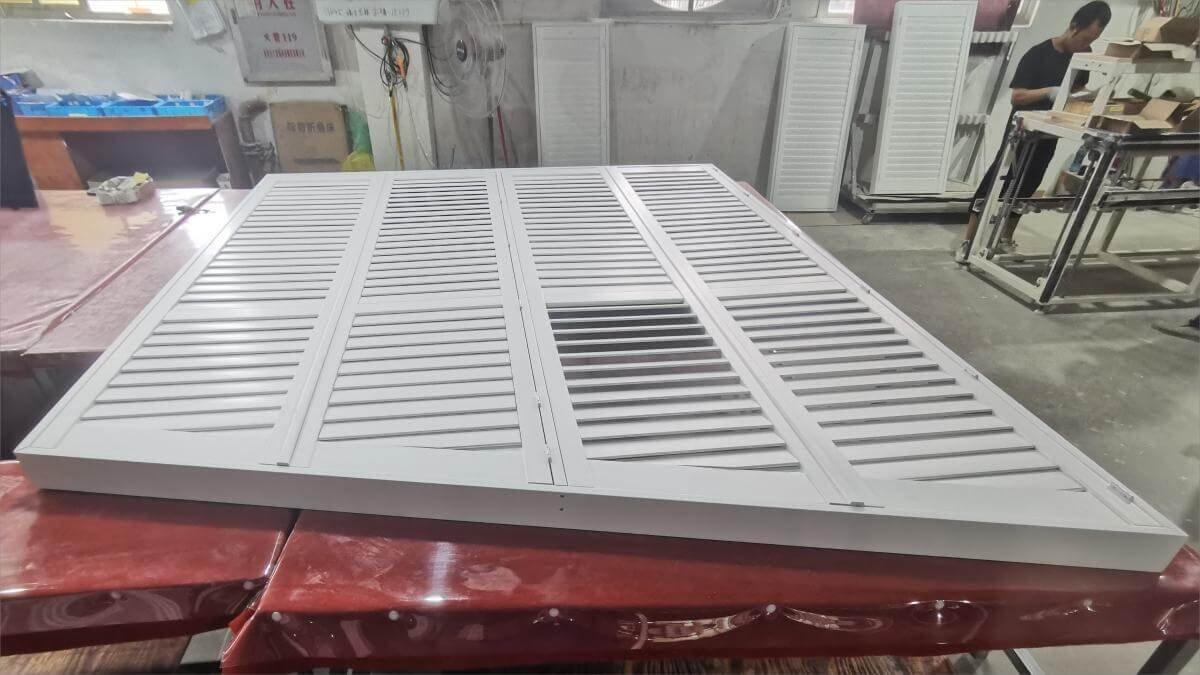
Most aluminium plantation shutters are specified in 6063 alloy, but the alloy number alone doesn't guarantee performance — temper does. Properly aged 6063-T5 aluminium carries a yield strength of roughly 145 MPa, compared with around 110 MPa for the more loosely time-aged T4 temper (per ASTM B221). The two tempers are visually identical, and T4 can lower material cost by roughly 8%, which is why it occasionally appears in lower-cost supply chains without being disclosed.
Under the repeated opening-and-closing torque a gear-tilt mechanism applies to each louvre's pivot pin, T4 aluminium is meaningfully more prone to micro-deformation: pivot holes can widen by 0.1–0.2mm within three to five years, eventually leaving louvres that won't hold their tilt position. The reliable way to verify temper is a hardness test — a Vickers hardness reading of 60 HV or above indicates true T5; readings below 55 HV typically indicate T4 has been substituted.
For coastal ANZ projects, corrosion resistance matters just as much. ASTM B117 salt-spray testing (5% NaCl, continuous spray at 35°C) is the standard reference: powder-coated aluminium hardware should withstand at least 500 hours without red rust for general use, with 1,000+ hours recommended for properties within roughly five kilometres of the coastline. Reaching 1,000-hour performance typically requires a dry film thickness of 60–80μm, well above the 35–40μm sometimes used to cut cost.
Timber Plantation Shutters: Sourcing Traceability
For timber — typically ash, basswood, or pine — the key verification point for eco-conscious wholesale buyers is FSC Chain of Custody certification (FSC-STD-40-004), which tracks material from log to finished shutter through every processing step. This is independently verifiable: the certificate number can be checked directly at info.fsc.org, confirming validity, the certifying body, and whether the certificate's product-category coverage actually includes plantation shutters rather than an unrelated product line. Certificates require annual renewal by an accredited body, so it's worth confirming current status rather than relying on marketing material alone.
The Quality Control System Wholesale Buyers Should Expect
A credible plantation shutters manufacturer should be able to describe — and document — a multi-stage QC process rather than a single inspection before shipment. A reasonable baseline structure looks like this:
| Stage | Purpose |
|---|---|
| IQC (Incoming Quality Control) | Inspect raw materials and components before they enter production |
| IPQC (In-Process QC) | Patrol checks during manufacturing, not only at the end of the line |
| FQC (Finished Goods QC) | 100% inspection of completed units |
| UV anti-yellowing test | Accelerated colour-stability testing under simulated sun exposure |
| Moisture-resistance structural test | Validates structural integrity under humid-climate conditions |
| Packaging compression test | Confirms cartons and pallets will withstand sea-freight stacking loads |
Two details that fall outside this table are worth asking about directly, because they're frequently overlooked even by factories that otherwise run a disciplined QC process.
Packaging and transit protection. Ocean freight from South China to Australia and New Zealand exposes containers to temperature swings of up to roughly 20°C as they cross different climate zones. Without adequate desiccant protection, water vapour condenses on the container's interior steel walls and drips onto cargo below — a real mould risk for timber-based product in particular. A reasonable industry standard is roughly 1kg of coarse-grain silica desiccant per 2m³ of container volume, distributed through the cargo layers rather than placed only at the floor, since condensation also forms on the walls and ceiling. Transit-readiness should also be validated against ISTA 2A testing — random vibration (4Hz–100Hz, roughly 90 minutes per axis) plus free-fall shock drops calibrated to product weight — with packaging finalised only after it passes that protocol.
Pre-shipment inspection timing. The correct point for a pre-shipment inspection (PSI) is after 100% of finished goods have been packed into their shipping cartons, but before the container is sealed — this is the only point that captures damage introduced during packing itself (impact, crushing, incorrect stacking). A common shortcut is inspecting at the finished-goods stage, before packing, which can produce a "passed" report while a meaningful share of cartons — commonly cited around 3% — arrive at destination already damaged from an unsupervised packing process.
Why Your First Sample Won't Match Your First Container
This is worth stating plainly, because it's one of the most common sources of dispute in international wholesale sourcing: samples are usually hand-finished individually, while bulk orders run through standard production lines. That gap doesn't close on its own, but it is manageable with three steps:
- Request a Pre-Production Sample (PPS), not a development sample. A PPS is made using the actual bulk-production materials and process, so it represents real batch quality far better than an early design sample does.
- Anchor the contract to the PPS. Specify in writing that bulk production tolerances are benchmarked against the agreed PPS, with a tolerance table attached to the contract rather than left as a verbal understanding.
- Schedule an in-process inspection (IPI) on first large orders. Having a third party inspect the run at roughly 50% completion leaves enough time to correct deviations — inspecting only after the goods are finished and packed does not.
Beyond the Factory Floor: MOQ, Lead Times, and Exclusivity
Technical capability is only part of the wholesale evaluation. A few commercial structures are worth confirming before committing volume to any single supplier:
- Minimum order quantity. A common structure is one 20-foot general-purpose container (20GP), with plantation shutters, venetian blinds, and window shades combinable within a single container — useful for distributors who don't yet need a full container of any one product line.
- Lead times. Typical ranges run 25–35 days for plantation shutters and 20–30 days for venetian blinds, based on a 20GP mixed container, with shorter 7–15 day lead times achievable for ready-made window shades.
- Sampling turnaround. A 3–7 day sampling lead time allows evaluation before committing to a full container order.
- OEM/ODM availability. Custom branding, packaging, and design development should be available for wholesalers building their own retail identity, rather than reselling under the factory's name.
- Regional exclusivity. Some manufacturers operate on a one-partner-per-region model, which protects a distributor's local marketing investment from being undercut by a second importer sourcing the identical product into the same market.
None of these commercial terms substitute for the technical checks above — a manufacturer with attractive lead times and MOQs but no documented PPS process or salt-spray data is still a quality risk waiting to surface after the first few containers.
Frequently Asked Questions
What is a typical MOQ for wholesale plantation shutters from a Chinese factory? Most factory-direct manufacturers set MOQ at one 20-foot container (20GP). Many allow plantation shutters, venetian blinds, and window shades to be combined within a single container, making it easier to reach the minimum without over-ordering one product line.
How long does plantation shutters production take for a wholesale order? Typical lead times run 25–35 days for plantation shutters based on a 20GP mixed container, plus ocean freight transit time. Project-based phased delivery can sometimes ship partial orders sooner for urgent restocking needs.
What's the difference between T5 and T4 aluminium in plantation shutters? T5-tempered 6063 aluminium has a yield strength of around 145 MPa versus roughly 110 MPa for T4. T5 resists pivot-pin wear far better under repeated use, while the two tempers look identical — verification requires a hardness test (Vickers ≥60 HV for true T5).
Why might a wholesale shipment fail quality checks that the factory sample passed? Samples are often hand-finished individually, while bulk orders run through standard production lines, creating a quality gap. Requesting a Pre-Production Sample made from bulk materials and processes, plus an in-process inspection partway through the run, both reduce this risk.
Is FSC certification available for timber plantation shutters? Yes — FSC Chain of Custody certification (FSC-STD-40-004) tracks timber from log to finished shutter. Buyers can verify a supplier's certificate number, validity, and product-category coverage directly at info.fsc.org rather than relying on the claim alone.
How can buyers verify a manufacturer's QC process before placing a large order? Ask for documentation of each QC stage — incoming inspection (IQC), in-process inspection (IPQC), and final inspection (FQC) — plus accelerated tests like UV anti-yellowing and moisture-resistance trials. Request that pre-shipment inspection occur after cartons are packed, not before.
Working With a Wholesale Partner, Not Just a Supplier
The manufacturers worth building a long-term wholesale relationship with are the ones willing to discuss extrusion tolerances, temper verification, and inspection timing in this level of detail — rather than steering every conversation back to price per unit. Bright Shutters manufactures plantation shutters in PVC, timber, and 6063-T5 aluminium from a single Shenzhen production base, supplies all three product lines in one mixed 20GP container, and operates on a one-partner-per-region model for Australian and New Zealand distributors. Get in touch to discuss sampling, lead times, and container planning for your market.