
Ask any Australian window covering distributor what keeps them up at night and lead time uncertainty will be near the top of the list. A builder calls on a Tuesday with a 14-unit apartment project that needs to be ready for settlement in 10 weeks. Your supplier quotes 8 to 10 weeks production. Freight takes 3 weeks. You are already cutting it to the wire before customs, container dehire, and last-mile delivery are factored in. You either say yes and hope everything goes to schedule, or you say no and watch the order go to a competitor who says yes.
Lead time is not just a logistics metric. It is a core determinant of which business you can win and which you cannot. This article explains why production lead time matters more than most distributors account for, what drives lead time variability in Chinese shutter factories, and why a 25 to 35 day production window changes the commercial calculus in ways that compound over time.
The Real Lead Time Calculation Most Distributors Get Wrong
When a factory quotes a lead time, they are quoting production time — the days between order confirmation and cargo ready. This is only one component of your total supply cycle. The full calculation, from the day you confirm an order to the day product is available in your warehouse, looks like this:
| Stage | Typical duration |
|---|---|
| Production (factory quoted lead time) | 25–35 days |
| Pre-shipment documentation and booking | 3–5 days |
| Sea freight (China to AU east coast) | 18–22 days |
| Port processing and customs clearance | 3–5 days |
| Container dehire and inland delivery | 2–4 days |
| Total supply cycle | 51–71 days |
At the shorter end — a factory with 25-day production, efficient documentation, and favourable port conditions — you are looking at approximately 51 days from order to warehouse. At the longer end, 71 days or more is common with factories operating at 40 to 50 day production cycles, particularly during peak periods.
The difference between a 51-day supply cycle and a 71-day supply cycle is 20 days. Over the course of a year, with four container cycles, that is 80 days of additional lead time — more than two full months of supply chain time you are not getting back.
What Drives Production Lead Time at the Factory Level
Understanding why lead times vary helps you evaluate factory claims and ask the right questions. Production lead time in a shutter factory is determined by four factors:
1. Production queue depth.
A factory running at full capacity with 60 days of orders in the queue will quote you 60 days lead time regardless of how efficient their production line is. A factory with a well-managed queue that maintains 20 to 30 days of forward bookings can consistently deliver in that window. Ask factories: "What is your current production queue?" and "How does your lead time vary between peak and off-peak periods?" Factories that cannot answer these questions clearly do not have strong production planning systems.
2. Production line capacity relative to order mix.
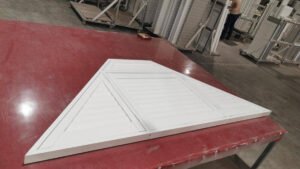
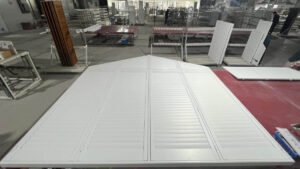
A factory that produces a narrow range of standard products can move faster than a factory handling large volumes of custom configurations. At our factory, we run 12 dedicated production lines and maintain separate scheduling tracks for standard stock-range orders and custom-specification orders. Standard range orders — the most common product types in our AU/NZ catalogue — are scheduled on a 25 to 28 day track. Complex custom orders (shaped panels, non-standard materials, specialty hardware) run on a 32 to 38 day track.
3. Material availability.
A factory that holds buffer stock of its primary materials — timber, PVC compound, aluminium extrusion, hardware — can start production within days of order confirmation. A factory that places material orders after receiving customer orders adds 7 to 14 days before production can begin. Ask factories: "Do you hold buffer stock of your primary materials for your standard range?" This is a meaningful operational question that separates well-capitalised factories from order-to-order operations.
4. Surface finishing capacity.
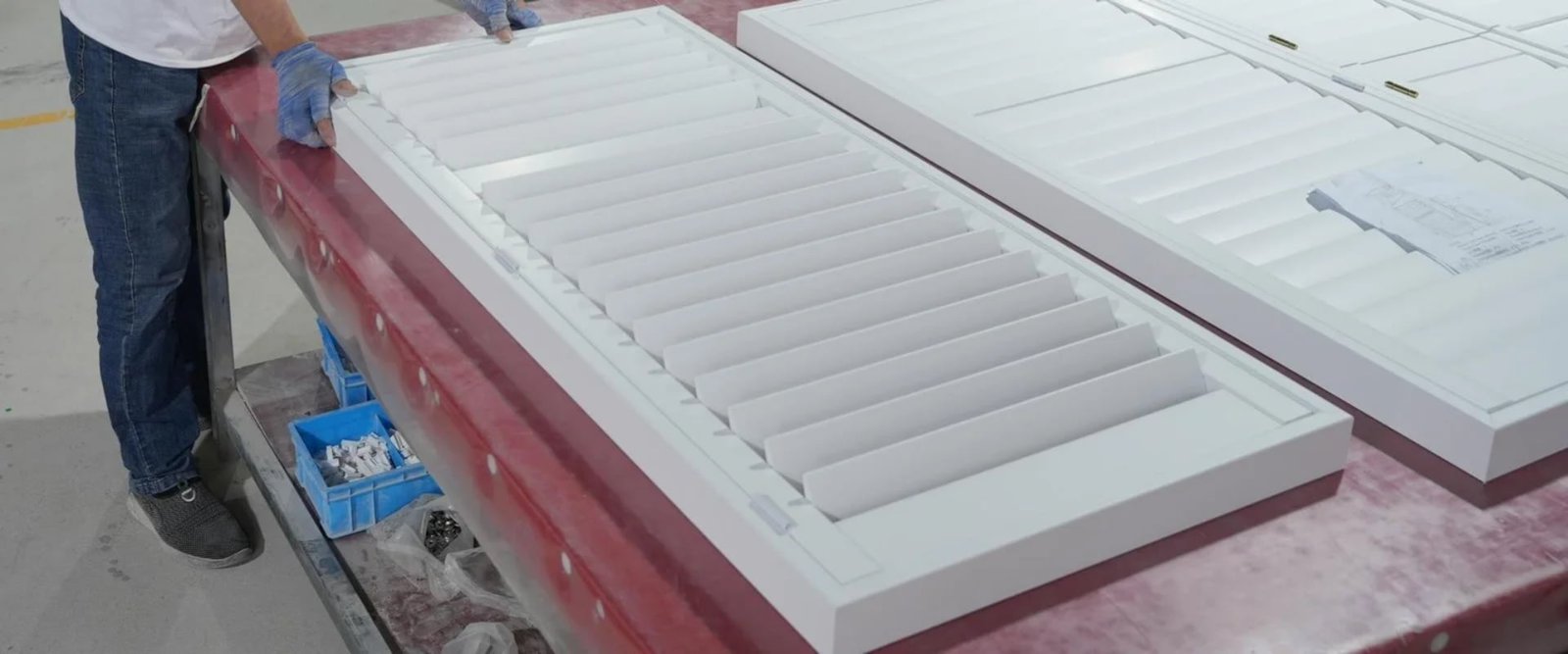
The spray painting and curing line is frequently the bottleneck in shutter production. A factory with three automated spray lines running two shifts can process 1,800 panels per day through finishing. A factory with one semi-automated line running one shift might process 400 panels per day. In both cases, the CNC and assembly lines might be comparable — but the finishing bottleneck determines the actual output rate. This is why production lead time claims from different factories with similar-looking production floors can vary by 15 days or more.
The Compounding Business Impact of Short Lead Times
The direct benefit of shorter lead times is obvious — you can say yes to more jobs on tighter schedules. But the compounding benefits are less immediately visible and cumulatively more significant.
Reduced buffer stock requirement.
Every day of lead time you carry in your supply cycle requires additional inventory holding to maintain service levels. A distributor with a 70-day supply cycle needs approximately 40% more safety stock than a distributor with a 50-day supply cycle selling the same volume, to maintain the same probability of having product available when a customer orders.
Less safety stock means less warehouse space, less capital tied up in inventory, and less write-down risk on slow-moving stock that has been held too long. At typical AU distributor inventory holding costs of 18 to 22% of stock value per year (including capital cost, storage, insurance, and obsolescence), reducing average inventory by AUD $50,000 saves approximately AUD $9,000 to $11,000 per year — from lead time alone.
More container cycles per year.
A 25-day production lead time and a 50-day total supply cycle allows approximately 7.3 container cycles per year if you reorder immediately on receipt. A 40-day production lead time and a 65-day total supply cycle allows approximately 5.6 container cycles per year. The difference — 1.7 additional container cycles — is 1.7 additional opportunities to turn your capital per year.
If each container generates AUD $35,000 in gross margin, the difference between 5.6 and 7.3 annual cycles is approximately AUD $59,500 in gross margin — from the same capital base, the same product range, and the same customers.
Faster response to demand spikes.
Building and renovation activity in Australia is cyclical and increasingly weather and season-dependent. Distributors who can respond to a demand spike with a rapid reorder — and receive product within 50 days — can capitalise on demand peaks that competitors with 70-day supply cycles miss entirely. The spring renovation season in Australia (September to November) typically produces a 30 to 40% increase in shutter enquiries. Distributors who run out of stock in October and wait until December for replenishment miss the peak. Distributors with short supply cycles reorder in September and receive replenishment before the peak fades.
How We Achieve 25 to 35 Day Production Consistently
We are stating 25 to 35 days as our production lead time commitment for AU/NZ distributors. It is worth explaining what makes this achievable.
Buffer material holding. We maintain 35 to 45 days of primary material stock for our standard AU/NZ range — basswood, paulownia, PVC compound, aluminium extrusion, and hardware. When an order is confirmed, production can typically begin within 48 to 72 hours of confirmation. We are not waiting for timber to arrive from a supplier before we start.
Dedicated AU/NZ production scheduling. Our Australian and New Zealand orders are scheduled on a dedicated track that prioritises standard range configurations. This means your order does not compete for line time with complex custom orders for other markets. We run two production shifts and maintain 12 production lines — our standard AU/NZ range occupies approximately 60% of our planning capacity, which gives us consistent throughput without queue spikes.
Three automated spray lines. The finishing bottleneck is managed. Three automated spray lines running two shifts gives us a finishing capacity of approximately 2,400 panels per day — sufficient to process a 20GP container worth of shutters through finishing within 4 to 5 days.
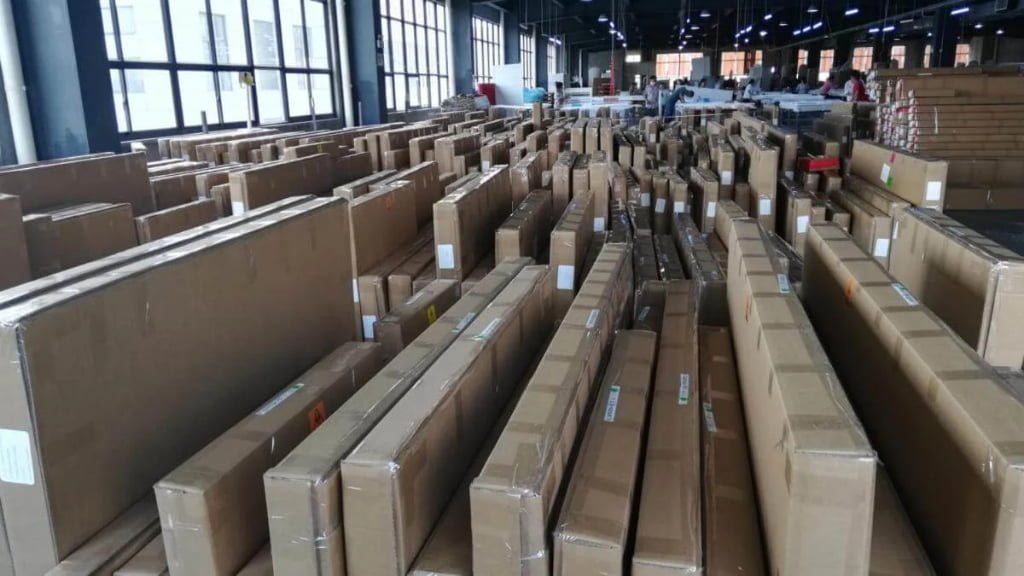
Proximity to port. Our factory is located [X] kilometres from [port name], with typical trucking time of 90 to 120 minutes to the container yard. We load and seal containers ourselves on the confirmed cargo ready date, without dependence on third-party logistics for the initial leg.
Pro Tip: When a factory quotes you a lead time, ask them what their lead time was for AU shipments in November and December of the last two years. The pre-Chinese New Year period (November to January) is when production queues peak and promised lead times slip most frequently. A factory that can demonstrate consistent lead times through that period has genuine production planning maturity — not just favourable conditions in a slow month.
How Lead Time Affects Your Customer Conversations
The commercial impact of a 25 to 35 day production lead time becomes most visible in customer conversations — specifically in your ability to give a reliable answer to the question "when can you have them installed?"
With a 25-day production lead time and a 50-day total supply cycle, your answer to a builder or developer who calls today is: "I can have product in my warehouse in 50 days, and installation can commence within a week of that — so you're looking at 57 to 60 days from today."
With a 40-day production lead time and a 65-day supply cycle, the same question gets a 72 to 77 day answer. On a project with a 90-day timeline to settlement, the difference between 60 days and 77 days is the difference between a comfortable schedule and a project where everything has to go perfectly.
Builders and developers work to settlement dates that carry financial consequences. A distributor who says "60 days" and delivers in 58 wins repeat business. A distributor who says "60 days" and delivers in 72 does not get called for the next project. Lead time reliability — not just lead time length — is what builds the trust that converts project customers into long-term accounts.
Want to discuss lead times and product availability for your next project or container order? Contact us here to request our current lead time schedule and AU/NZ product catalogue.
Related reading: Case Study: Building a Shutter Distribution Business with Factory Direct Pricing