
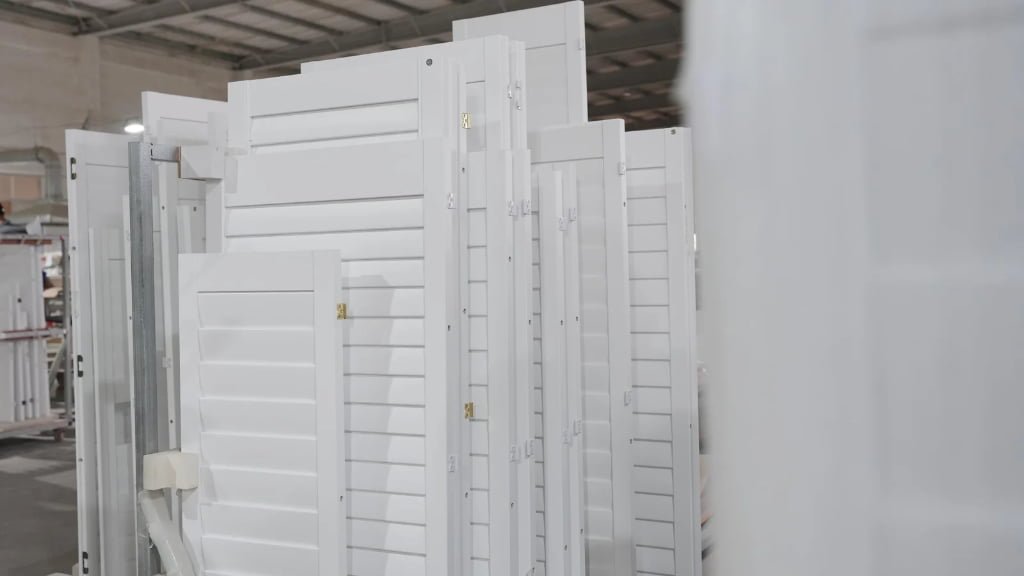
Walk into any window covering showroom in Australia and you'll find plantation shutters in three materials — PVC, solid wood, and aluminium. Ask the sales staff which is best and most will give you a vague answer, because the honest answer depends entirely on who the customer is, where the shutters are going, and what margin structure works for your business.
We manufacture all three at our factory in China and ship thousands of containers to Australian distributors every year. This article is written from that vantage point — not to tell you which material is "best," but to give you the distributor-level information you actually need to stock the right product mix and position each material correctly in your market.
The Three Materials at a Glance
Before going deep on each, here is how the three materials compare across the dimensions that matter most to distributors:
| PVC | Solid Wood | Aluminium | |
|---|---|---|---|
| Price point | Entry to mid | Mid to premium | Premium |
| Typical AU retail margin | 45–55% | 50–65% | 55–70% |
| Weight (63mm louvre, per m²) | ~3.8 kg | ~5.2 kg | ~4.1 kg |
| Moisture resistance | Excellent | Moderate | Excellent |
| UV / fade resistance | Good (UV-stabilised) | Good (with correct primer) | Excellent |
| Maximum panel size | Up to 2,400mm H | Up to 2,700mm H | Up to 3,000mm H |
| Paintable / repainting | No | Yes | Powder coat only |
| Lead time (our factory) | 25–30 days | 28–35 days | 30–38 days |
| Best application | Bathrooms, budget resi | Living rooms, premium resi | Commercial, coastal, large openings |
| Warranty (our factory) | Lifetime structural | Lifetime finish, 10yr structural | 10yr structural |
This table gives you the skeleton. The sections below give you the reasoning behind each number.
PVC Plantation Shutters — The Volume Driver
PVC is the material that built the modern Australian plantation shutter industry. It accounts for approximately 60% of the residential shutter market by volume, and for most distributors it is the product that funds everything else.
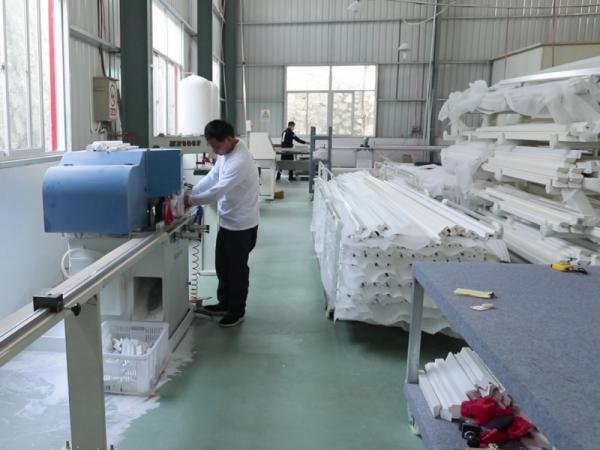 Why buyers choose PVC:
The pitch is simple — it won't warp, it won't swell, and it won't yellow, backed by a lifetime structural warranty. For Australian homeowners going into bathrooms, kitchens, laundries, or any room with elevated humidity, PVC removes the risk entirely. It is also the entry-level price point, which means it converts browsers into buyers faster than wood or aluminium.
What distributors need to know about quality variation:
Not all PVC shutters are the same, and this is where most of the quality problems in the market originate. The key variables are:
- PVC compound grade. Cheap shutters use recycled or filler-heavy PVC that becomes brittle and yellows within 3 to 5 years. Premium shutters use virgin PVC with UV stabilisers compounded throughout — not just surface-coated. At our factory, we use only virgin PVC compound with a UV stabiliser concentration of ≥2.8%, which is the threshold required for our lifetime structural warranty.
- Wall thickness. Budget louvres use thin-wall extrusion to reduce material cost. Our 63mm louvre has a wall thickness of 2.8mm — sufficient to resist deflection on panels up to 2,400mm height without a mid-rail.
- Foam fill. Some manufacturers fill PVC louvres with foam to simulate the feel of wood. We do not. Foam fill complicates recycling, retains moisture if the surface is scratched, and adds weight without adding strength.
The margin story:
PVC has the lowest unit price but the fastest volume turn. For a distributor supplying residential builders, a standardised PVC range in 5 colours (white, antique white, grey, beige, black) with reliable lead times and consistent quality is a repeatable revenue stream. The margin per panel is lower than wood, but the order frequency is higher and the product complexity is lower.
Solid Wood Plantation Shutters — The Premium Offer
Solid wood shutters are where the market separates itself. They command a higher retail price, attract a different buyer, and when positioned correctly, deliver significantly better margin per panel than PVC.
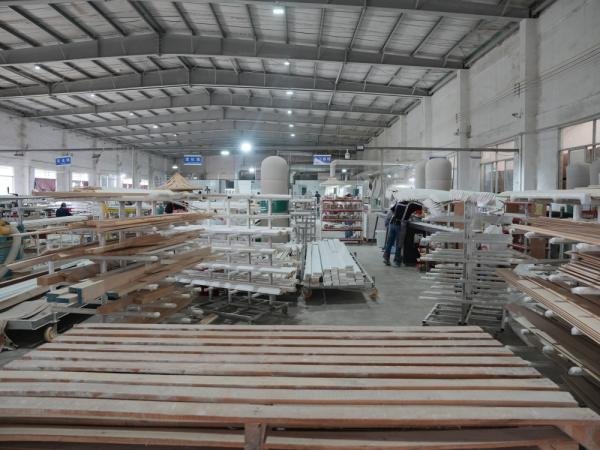
The three species and when to use each:
Basswood is the benchmark. It is the lightest structural hardwood available, takes paint more cleanly than any other species, and has the tight grain that prevents paint absorption variation across a panel. For premium residential projects — lounge rooms, main bedrooms, high-end builder specifications — basswood is the right answer. Our basswood is sourced from managed forests and carries FSC certification, which is increasingly required for green-star rated residential developments.
Paulownia is gaining ground in the Australian market, particularly for large panels. It is 20 to 25% lighter than basswood at equivalent dimensions, which matters structurally on bi-fold panels wider than 600mm or heights above 2,200mm. It is naturally resistant to moisture and insects, and takes paint well. The trade-off is a slightly coarser grain that can telegraph through thin paint coats — we apply a grain-filling primer as standard on paulownia panels to eliminate this.
Finger-joint pine is the entry-level wood option. Structurally sound and very cost-effective, but the finger-joint lines can show through lighter paint colours if the primer schedule is not correct. We recommend finger-joint pine only for painted finishes in colours above NCS 3000 (mid to dark tones), not for pure whites.
The margin story:
Solid wood shutters have two margin advantages over PVC. First, the unit margin in dollar terms is higher — a 63mm basswood panel in a standard residential window will typically retail for 30 to 45% more than its PVC equivalent. Second, wood opens the door to custom colour, custom size, and custom species specifications that carry premium pricing and are difficult for a competitor to undercut on price alone. Our colour lab can match any RAL or NCS code and deliver consistent batch-to-batch results across multiple reorders.
Aluminium Plantation Shutters — The Specialist Product
Aluminium is the smallest volume category of the three, but it carries the strongest margin and serves applications that neither PVC nor wood can cover adequately.
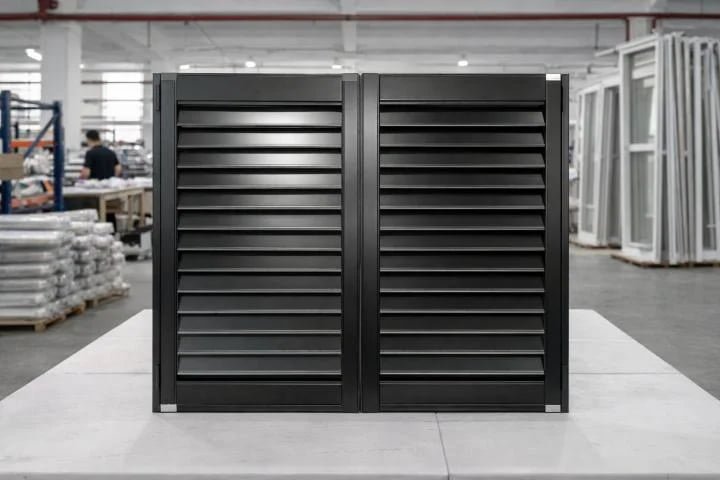
Where aluminium wins:
- Coastal and marine environments. Salt air degrades timber finishes and causes PVC compound to degrade faster than its inland equivalent. Powder-coated aluminium is impervious to both.
- Large commercial openings. We manufacture aluminium panels up to 3,000mm height and 900mm wide — dimensions that are structurally impossible in solid wood and inadvisable in PVC without a mid-rail. Hotels, apartment buildings, and commercial fit-outs often require this scale.
- Outdoor and semi-outdoor applications. Covered pergolas, alfresco areas, and screened verandas — environments with direct weather exposure — are aluminium-only territory.
What to know about our aluminium range:
Our aluminium shutters use 6063-T5 grade aluminium extrusion, which is the architectural standard for powder-coated joinery. The extrusion wall thickness is 1.8mm on louvres and 2.2mm on frames. Powder coat is applied at 60 to 80 microns dry film thickness, which is AAMA 2604-compliant and provides a 10-year finish warranty against fading, chalking, and peeling under direct sun exposure.
We offer 16 standard powder coat colours and can match any RAL or AS/NZS 4506 colour on minimum order quantities of 20 panels.
The margin story:
Aluminium shutters retail at a significant premium to both wood and PVC, and they are sold into projects where the buyer is not shopping primarily on price — they need the product to perform in a specific environment and they know it. Distributor margins on aluminium are typically 55 to 70% on standard projects, and can exceed this on custom large-format commercial orders where your knowledge of lead times and lead times gives you negotiating room.
The volume is lower, but the revenue per order is substantially higher. Aluminium works best as a complementary product in a distributor's range — not the lead product, but the answer when a customer asks "what do I do with the outdoor alfresco?"
Which Material Should Your Business Lead With?
The honest answer is: all three, in the right proportion for your customer mix.
A well-structured distributor range looks something like this:
- PVC: 55 to 65% of container volume. Standard residential range in 4 to 6 colours, tight size tolerances, consistent quality. This is your volume engine and your new customer acquisition product.
- Solid Wood (Basswood): 25 to 35% of container volume. Premium residential and builder specification range. 2 to 3 species, custom colour capability, FSC-certified option. This is your margin driver.
- Aluminium: 5 to 15% of container volume or a separate aluminium-only order when project volume justifies it. Coastal and commercial applications. This is your specialist offer that competitors without aluminium capability cannot match.
We regularly ship mixed containers with all three materials — 20GP containers with 20 to 40 SKUs across PVC, wood, and aluminium are our most common format for established Australian distributors. If you are building your range from scratch, we typically recommend starting with a PVC-majority first container to establish sales velocity, then adding wood and aluminium on the second or third order once you understand your local demand.
Ready to discuss the right product mix for your market? Contact us here to request our wholesale catalogue with current pricing across all three material ranges.
Related reading: How We Make Plantation Shutters: A Step-by-Step Factory Walk-Through