For ANZ wholesale buyers sourcing plantation shutters from China, the supply chain does not end when the factory confirms production completion. The 18–26 days between factory loading and port arrival in Sydney, Melbourne, or Auckland contain a distinct set of risks that require their own management attention.
This article covers everything ANZ buyers need to know about shipping plantation shutters from Chinese manufacturers — transit timelines, container loading requirements, packaging standards, regulatory compliance, and the specific risks of the Pacific route.
Transit Times: Realistic Expectations
Ocean freight transit times from major Chinese manufacturing and export hubs to ANZ ports:
| Origin | Destination | Standard Transit |
|---|---|---|
| Shenzhen / Guangzhou | Sydney | 18–22 days |
| Shenzhen / Guangzhou | Melbourne | 20–24 days |
| Shenzhen / Guangzhou | Brisbane | 19–23 days |
| Shenzhen / Guangzhou | Adelaide | 22–26 days |
| Shenzhen / Guangzhou | Perth | 16–20 days |
| Shanghai | Sydney | 14–18 days |
| Shanghai | Melbourne | 16–20 days |
| Shenzhen | Auckland | 22–26 days |
| Shenzhen | Christchurch | 24–28 days |
These are direct or single-transshipment service transit times. Multi-transshipment services (common for less-than-container loads) add 5–10 days.
Planning the full timeline: Add production lead time (25–35 days for standard plantation shutter specifications from a dedicated manufacturer) to transit time, plus 2–4 days for customs clearance and local cartage after arrival. Your realistic origin-to-warehouse timeline from order confirmation is 50–65 days for most ANZ delivery points.
This timeline has two important commercial implications: you are carrying 50–65 days of inventory in the supply chain, and any quality issue discovered at destination cannot be corrected faster than another full cycle.
Container Selection: 20GP vs 40HQ
Most plantation shutter wholesale orders from ANZ distributors ship in one of two container types:
20GP (20-foot General Purpose): Internal dimensions approximately 5.9m × 2.35m × 2.39m. Standard for first orders and moderate volume buyers. Typical capacity: 280–350 sets of mixed plantation shutters depending on specification mix.
40HQ (40-foot High Cube): Internal dimensions approximately 12.03m × 2.35m × 2.69m. The higher internal height (2.69m vs 2.39m) provides meaningful additional stacking capacity for tall shutter panels. Typical capacity: 600–750 sets.
For plantation shutters specifically, the 40HQ is often more efficient than a standard 40GP because shutter panels for full-height windows (2.1m, 2.4m) benefit from the additional height clearance, reducing the need to lay panels flat and maximising cartons-per-container count.
The Container Rain Problem
Container rain is one of the most underestimated risks in Pacific Ocean freight — particularly relevant for timber products and for shipments that transit between tropical and temperate climate zones.
Here is what happens: a container loaded in Shenzhen during summer (30°C, 75% relative humidity) enters a refrigerated environment as it moves through cooler Pacific air masses. The warm, moisture-laden air inside the container contacts the cold steel walls. Moisture condenses, runs down the walls, and collects on the lowest-stacked cargo.
For timber plantation shutters, this condensation exposure — even at modest levels — can cause surface moisture absorption that initiates the same warping process as a manufacturing moisture content defect: the outer surface absorbs ambient moisture while the core remains dry, creating the differential that drives dimensional change.
For PVC and aluminium shutters, container rain creates a different problem: moisture trapped inside cartons can produce surface bloom or mild corrosion on exposed metal hardware during the 3–4 week transit period.
The mitigation protocol that professional shutter manufacturers use for ANZ routes:
-
Silica gel desiccant: place at a rate of approximately 1kg of desiccant per 2m³ of container volume. Critically, distribute the desiccant throughout the cargo — between pallet layers, not just at the container doors. Desiccant at the container ends does not protect cargo in the middle of a 12-metre 40HQ.
-
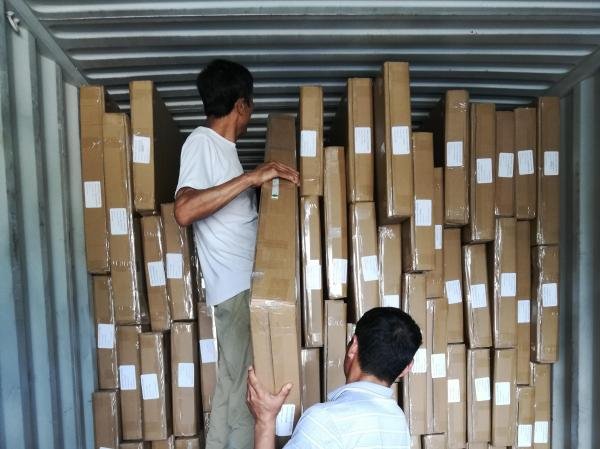
Full PE film wrapping: each pallet of product should be fully wrapped in polyethylene film before container loading. This creates an additional moisture barrier between the condensed water dripping from container walls and the product cartons.
-
Waterproof carton specification: the outer carton should be specified at a minimum burst strength of 600kPa with moisture-resistant corrugation. Standard single-wall corrugated cartons are inadequate for Pacific route moisture exposure.
Ask your supplier to confirm their export packaging specification includes all three elements. At Bright Shutters, our Pacific route packaging standard includes desiccant at 1kg/2m³ (distributed, not consolidated), full PE pallet wrap, and double-wall moisture-resistant cartons for all ANZ shipments.
ISPM 15: Non-Negotiable Biosecurity Compliance
Australia and New Zealand both apply ISPM 15 (International Standards for Phytosanitary Measures No. 15) to all imported timber packaging materials. This includes:
- Timber pallets (solid timber pallets, not plastic or pressed wood panels)
- Wooden crates and packing cases
- Timber dunnage (wood used to brace or support cargo within a container)
- Solid wood spacers and separators within cartons
The required treatment is heat treatment (HT): the entire timber cross-section must reach a core temperature of 56°C for a minimum of 30 continuous minutes. The treatment is evidenced by an ISPM 15 stamp on the packaging material, showing the country code, producer code, and treatment method (HT).
The practical risk: ISPM 15 non-compliance is a biosecurity border issue in both Australia and New Zealand. The consequences are detention of the shipment at the importer's expense for treatment, or return of the shipment to origin. Either outcome disrupts your supply chain and creates costs that are not recoverable from the ocean freight carrier.
The practical verification: before container loading, request confirmation that all timber packaging in the shipment carries the ISPM 15 HT stamp. This should be a line item on your supplier's pre-shipment inspection checklist.
Customs and Import Duty in Australia and New Zealand
Australia:
- Plantation shutters (window shutters): typically classified under HS Code 3925.20 (plastic) or 4418.90 (wood) depending on primary material
- General import duty rate: 5% on CIF value (Cost, Insurance, Freight)
- GST: 10% on CIF + duty value
- As of current FTA status: no preferential duty rate applies between Australia and China under ChAFTA for most shutter products — standard MFN rates apply
- Customs declaration requires: commercial invoice, packing list, bill of lading, certificate of origin, FSC transaction certificate (if FSC claimed)
New Zealand:
- General import duty rate: typically 5–6.5% depending on HS classification
- GST: 15% on CIF value
- NZCFTA (NZ-China FTA) provides preferential rates for qualifying products — confirm HS code eligibility before assuming preferential treatment
- Biosecurity declaration required for all timber content (including packaging)
Insurance for Plantation Shutter Shipments
Ocean freight insurance is not included in standard freight quotes — it must be separately arranged. For plantation shutter shipments, the relevant coverage is:
All-risk marine cargo insurance: covers physical loss or damage during transit from any external cause, including container rain damage, handling damage, and theft. Typically priced at 0.3–0.8% of insured value for Pacific routes.
Institute Cargo Clauses (A): the broadest standard marine cargo coverage, covering all risks of physical loss or damage except the standard exclusions (inherent vice, wilful misconduct, nuclear, war). This is the appropriate minimum for a full container of plantation shutters.
Insurers may request product-specific packing details for high-value claims. Maintain your supplier's packing specification on file.
Receiving Your Shipment: What to Check Immediately
When your container arrives at your warehouse, the inspection sequence matters:
-
External container inspection before unsealing: document any visible damage to the container exterior (dents, holes, broken seals). If the container seal number does not match the bill of lading, do not sign the delivery receipt without noting the discrepancy.
-
Open 10–15% of cartons before the transport company departs: note any damage on the delivery receipt. Signing an unconditioned receipt eliminates your claim against the carrier.
-
Check for container moisture signs: water marks on lower carton tiers, damp corrugation, or visible condensation residue indicate container rain occurred. Document with photographs before disturbing cargo.
-
Cross-check quantity against packing list: plantation shutter cartons should have barcode labels identifying contents — verify carton count and spot-check contents against packing list.
Bright Shutters: China to ANZ Supply Chain
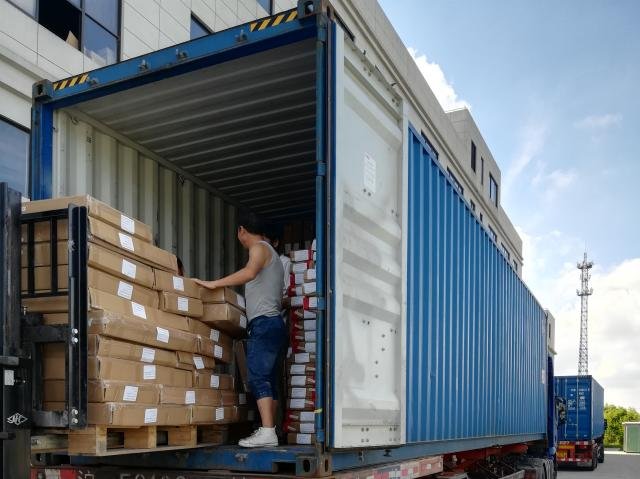
Our Shenzhen facility ships to ANZ wholesale buyers on a regular fortnightly container schedule. Our standard Pacific route packaging specification — desiccant, PE film wrapping, ISPM 15-compliant timber packaging, double-wall moisture-resistant cartons — is applied to all ANZ orders without requiring additional specification.
Production lead time for standard specifications is 25–35 days from order confirmation. We provide full pre-shipment documentation including commercial invoice, packing list, bill of lading, FSC transaction certificate, ISPM 15 confirmation, and inspection report as standard with each shipment.
Enquire about wholesale supply for your ANZ territory →
Related reading: Sourcing Plantation Shutters from China: The Complete ANZ Guide → How to Verify a Chinese Shutter Manufacturer →
Key Takeaways
- Realistic origin-to-warehouse timeline: 50–65 days from order confirmation
- 40HQ containers are more efficient than 40GP for tall plantation shutter panels
- Container rain is a real risk on Pacific routes: specify desiccant at 1kg/2m³ (distributed), PE film wrapping, and moisture-resistant cartons
- ISPM 15 heat treatment is non-negotiable — verify HT stamps before container loading
- Conduct 10–15% carton inspection before signing delivery receipt from carrier
Frequently Asked Questions
How long does shipping take from China to Australia?
Ocean freight from Shenzhen or Guangzhou to Sydney typically takes 18–22 days; to Melbourne, 20–24 days; to Perth, 16–20 days. Adding production lead time (25–35 days) and customs clearance (2–4 days), the realistic origin-to-warehouse timeline from order confirmation is 50–65 days.
What is ISPM 15 and why does it matter for my shutter shipment?
ISPM 15 is the international phytosanitary standard requiring heat treatment of all solid timber packaging materials in international trade. Australia and New Zealand biosecurity authorities enforce this at the border — shipments with non-compliant timber packaging face detention, mandatory treatment at importer expense, or return to origin.
What container size should I use for plantation shutters?
A 20GP container fits approximately 280–350 mixed plantation shutter sets and is standard for first orders and smaller volume buyers. A 40HQ container (higher internal roof) is more efficient for tall panel specifications, fitting 600–750 sets and providing better utilisation on orders above mid-volume thresholds.
Does Australia charge import duty on plantation shutters from China?
Australia applies a standard 5% import duty (MFN rate) on the CIF value of plantation shutters imported from China, plus 10% GST on the CIF plus duty value. The China-Australia FTA (ChAFTA) preferential rates generally do not apply to most shutter product classifications — confirm your specific HS code with your customs broker before assuming preferential treatment.