

The single most common question we get from new Australian distributors before their first order is about minimum order quantities. The second most common question — from experienced distributors — is how to structure a mixed container to get maximum commercial value without tying up too much capital in slow-moving stock.
These are not the same question, but they have the same answer: mixed containers work, and most established AU distributors use them. A 20GP container does not need to be filled with one product in one material at one size. Our most active Australian accounts regularly ship 20 to 35 distinct SKUs in a single container — plantation shutters, venetian blinds, and roller shades all in the same shipment.
This article explains how mixed containers work in practice, how to structure the SKU mix intelligently, and how to avoid the inventory pitfalls that catch first-time importers.
Why Mixed Containers Make Commercial Sense
Before getting into the mechanics, it is worth being clear on why mixed containers exist and why they are genuinely better than separate single-product shipments for most distributors.
You reduce freight cost per unit. A 20GP container costs roughly the same to ship whether it carries 900 identical white PVC shutters or 600 PVC shutters, 200 venetian blinds, and 100 roller shades. If you need all three products, consolidating them into one shipment cuts your freight cost per unit significantly compared to three separate shipments.
You reduce your average inventory cycle time. When you import a product-only container, you are betting your entire freight investment on that product selling through at the velocity you projected. A mixed container spreads that bet. If your PVC shutters sell faster than expected, you have venetian blinds bridging your revenue while you wait for the next shutter order to arrive.
You can test new products with low risk. A new product SKU at 60 to 80 units in a mixed container is a low-risk market test. If it sells, you have data to justify ordering a larger quantity next time. If it moves slowly, you have not committed your entire container to a product that does not work in your market.
You match your product range to your customer's full need. A customer who comes to you for plantation shutters and venetian blinds — and gets a competitive quote on both from the same supplier with the same lead time — is a customer who does not need to go anywhere else. Range breadth is a retention tool.
The Golden Rule: Anchor Products vs Test Products
Every well-structured mixed container has two categories of product, and keeping them distinct is the key to not ending up with a warehouse full of slow-moving stock.
Anchor products are SKUs you already sell or are highly confident will sell at the volumes you are ordering. These should make up 60 to 70% of your container volume. They are your core range — the products you can sell without effort because you already know the demand. The purpose of anchor products is to ensure that even if every test product disappoints, the container still pays for itself.
Test products make up 30 to 40% of container volume. These are products you want to introduce, sizes you have not stocked before, a different material or colour, or a product category you are moving into for the first time. Quantities should be conservative — 50 to 100 units per new SKU for a first test, not 200 to 300.
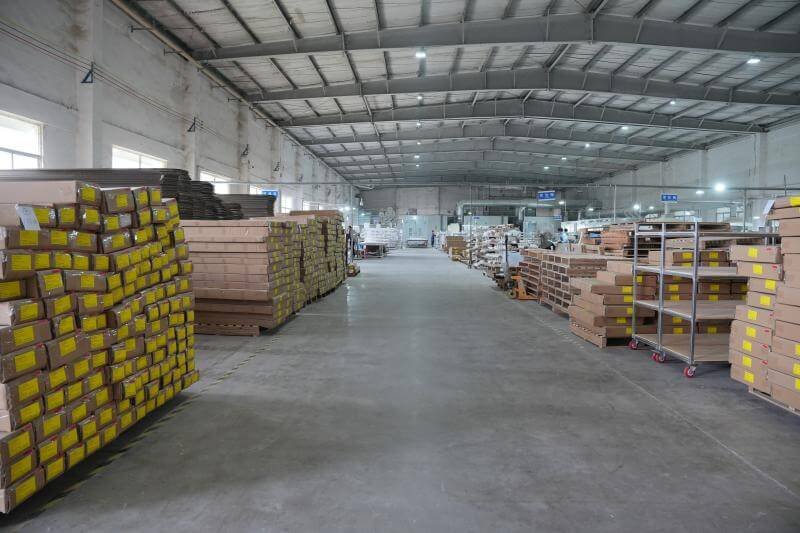
The discipline of this ratio matters. We regularly see new importers flip it — 70% test products, 30% anchor products — because they are excited about their new range. Six months later they have a full warehouse and a cash flow problem. The 60/40 rule is not conservative; it is what allows you to grow your range sustainably across multiple container cycles.
Pro Tip: Your anchor products should be products you can reorder confidently. Before adding an SKU to the anchor category, ask yourself: "If I had twice as many of these arrive, could I sell through them within 90 days?" If yes, it is an anchor. If no, it is a test.
How to Calculate Container Space
A 20GP container has an internal volume of approximately 33 cubic metres and a floor area of approximately 14.8 square metres. The actual usable volume for shutters and blinds depends on how the product is packaged and whether it is palletised.
Here are the working numbers we use when planning mixed containers for AU distributors:
Plantation shutters (standard residential sizes, 63mm louvre):
- Average carton size: 120cm L × 60cm W × 18cm H
- Average panels per carton: 4 to 6 panels (size-dependent)
- 20GP capacity: 900 to 1,100 panels total
Venetian blinds (standard AU widths, 25mm or 50mm aluminium):
- Average carton size: 200cm L × 30cm W × 30cm H
- Average blinds per carton: 8 to 12 blinds
- 20GP capacity: 1,200 to 1,800 blinds total
Roller shades (standard tube diameter, fabric rolled):
- Average carton size: 220cm L × 25cm W × 25cm H
- Average shades per carton: 6 to 10 shades
- 20GP capacity: 1,400 to 2,000 shades total
Mixed container working calculation:
Because different products have different packaging dimensions and weights, the practical approach is to plan by the volume each product category occupies rather than by unit count. A rough working rule for mixed containers:
- Every plantation shutter panel occupies approximately 0.025 to 0.035 cubic metres of container space (carton + packing allowance)
- Every venetian blind occupies approximately 0.015 to 0.020 cubic metres
- Every roller shade occupies approximately 0.012 to 0.018 cubic metres
If you are planning a container with 600 shutter panels, 300 venetian blinds, and 200 roller shades, the approximate volume calculation is:
- Shutters: 600 × 0.030 = 18.0 m³
- Venetian blinds: 300 × 0.018 = 5.4 m³
- Roller shades: 200 × 0.015 = 3.0 m³
- Total: 26.4 m³ (within the 33 m³ 20GP capacity, with buffer for packing materials)
Pro Tip: Always leave 10 to 15% buffer in your container calculation. Actual carton dimensions vary from product to product and we pack for protection rather than pure volume efficiency. Overfilling a container is not possible once the loading is done, but an overfilled plan causes reshuffling and delays. Our logistics team will confirm the final volume calculation before production begins.
A Real Example: What a Mixed Container Looks Like
Here is a simplified version of a mixed container we shipped to a distributor in Victoria earlier this year:
| Product | Material | Colour | Size range | Qty | Category |
|---|---|---|---|---|---|
| Plantation shutters 63mm | PVC | Vivid White | 600H–1800H × 400W–900W | 420 panels | Anchor |
| Plantation shutters 63mm | PVC | Antique White | 600H–1500H × 400W–750W | 180 panels | Anchor |
| Plantation shutters 89mm | Basswood | Vivid White | 900H–2100H × 500W–900W | 120 panels | Test |
| Venetian blinds 25mm | Aluminium | White/Silver/Charcoal | 900W–2400W | 240 blinds | Anchor |
| Venetian blinds 50mm | Timber look | Oak/Walnut | 900W–1800W | 80 blinds | Test |
| Roller shades | Blackout fabric | White/Grey | 900W–2100W | 160 shades | Test |
Total: 1,200 panels/units across 6 SKU groups, 20GP container.
Anchor products (PVC shutters + aluminium venetians) = 840 units = 70% of container. Test products (basswood shutters + timber-look venetians + roller shades) = 360 units = 30% of container. The distributor had strong confidence in the anchor products based on 18 months of previous sales data. The test products were new additions to their range.
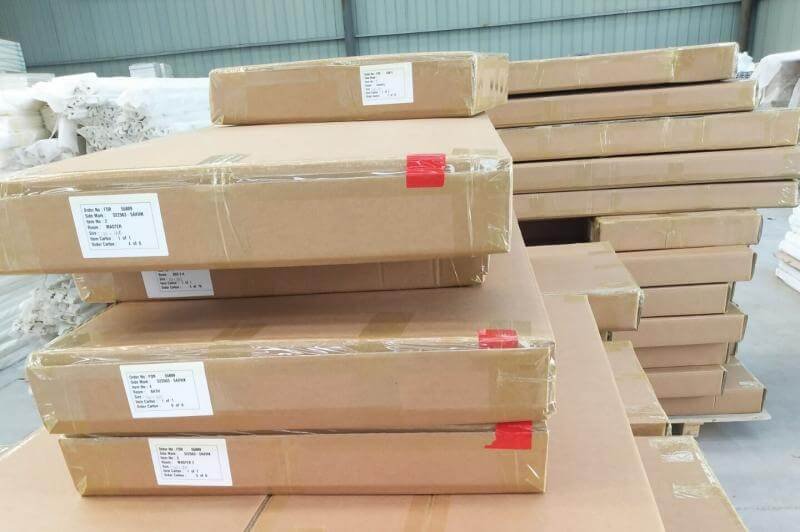
This distributor's anchor products sold through within 8 weeks of arrival. The basswood shutters moved within 12 weeks. The timber-look venetians and roller shades took 16 weeks — slower than expected, but within acceptable range, and they now have the data to decide whether to reorder or adjust the mix on the next container.
Practical Tips for Managing Mixed Inventory After Delivery
The container arriving is not the end of the process — it is the beginning of inventory management. A few practices that experienced AU importers use:
Label every carton with a location code before it goes into racking. Mixed containers mean mixed cartons from multiple product lines. If every carton is not clearly labelled with a location code on arrival, picking errors and mislabelling will cost you time for months afterwards. Our cartons include a scannable barcode that links to the product specification, but adding your own internal location code at receiving is worth the 30 minutes it takes.
Set a reorder trigger before you start selling. For each anchor SKU, set a reorder trigger quantity — the stock level at which you need to place a new order to avoid a stockout given your lead time. For an AU importer with a 55-day total lead time, a reorder trigger of 8 to 10 weeks of sales is appropriate. If you sell 40 panels per week, your reorder trigger is 320 to 400 panels. Set this in your inventory system on day one, not when you are already running low.
Track slow movers at 30, 60, and 90 days. Any test SKU that has not generated a single sale within 30 days needs a selling push — a price promotion, a display position change, or a conversation with your sales team about whether they understand the product. Any test SKU with zero sales at 90 days needs a decision: liquidate it, convert it to a display piece, or accept it as a slow-moving stock holding. Do not let slow movers silently consume warehouse space and capital indefinitely.
Pro Tip: Your best data for planning the next container is your current stock turn by SKU, not your intuition about the market. Before you draft your next container plan, pull a stock turn report and rank your SKUs from fastest to slowest. Add more of the fastest movers. Cut or replace the slowest. The market tells you what to stock if you listen to the data.
A Mixed Container Is a Business Strategy, Not Just a Logistics Decision
Done right, a mixed container is how you build a comprehensive window covering range without the capital risk of separate full-container orders for each product category. It is how you test new products without betting the business on them. And it is how you keep a customer who needs shutters, venetian blinds, and roller shades — all from one supplier, one lead time, one freight cost.
We have been helping Australian distributors plan mixed containers for over 15 years. Our logistics team will calculate volume, confirm product compatibility, and schedule production across multiple product lines on a single order — so the container arrives as a single coordinated shipment, not a series of partial deliveries.
Ready to plan your next mixed container? Contact us here to request our full product catalogue across plantation shutters, venetian blinds, and window shades — with current pricing and a sample programme.
Related reading: The Complete Guide to Sourcing Plantation Shutters from China (for AU/NZ Importers)